
Vietnam: The country’s success story is threatened by the US trade war

Highlights
- Vietnam’s high economic resilience and performance over the past decade have been driven by the manufacturing sector and exports.
- Macroeconomic fundamentals look strong, with the exception of foreign exchange reserves that are just under adequate levels.
- Vietnam’s role in supply chains is at a particularly high risk from US import tariffs, the crackdown against Chinese goods circumventing US tariffs and US pressures to cut ties with China.
- The country’s economic model, which gives prevalence to its ties with the US and China, is vulnerable amid the US-China rivalry and will require more diversification in trade partners.
- Faced with a very challenging outlook, Credendo’s political risk ratings remain unchanged for the time being.
Pros
Cons
Head of State
Head of Government
Population
GNP per capita
Income group
Main export products
Macroeconomic fundamentals strengthened by a manufacturing hub
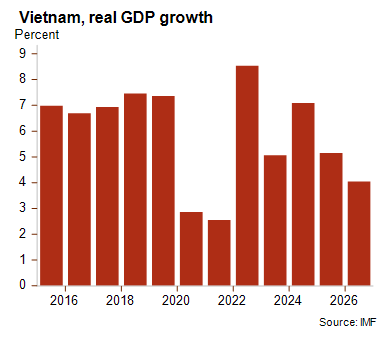
Vietnam has one of the strongest performing economies in Asia. Its resilience has been highlighted by an average 6.7% GDP growth recorded in 2001–2019, an absence of recession related to the Covid pandemic (+2.9% in 2020 and +2.6% in 2021) and a continued robust momentum (+6.9%) in 2022–2024. Among the multiple factors explaining its success story, the manufacturing sector and exports stand out as the main drivers. For many years now, Vietnam has become a reference destination for foreign direct investment (FDI), a major South-East Asian exporter of manufactured goods – for an increasingly broad range of products such as garments, footwear, electronics, smartphones, etc. – and more recently a beneficiary from shifting supply chains, particularly the “China+1” strategy adopted by companies wishing to circumvent US trade tariffs on China. With its dynamic economy, favourable investor framework with supportive domestic authorities, skilled workforce and relatively competitive labour costs, Vietnam is indeed seen as a good alternative to China, albeit on a much lower scale. Therefore, many multinationals, such as Samsung, Intel, Apple and others, have set up factories over the past decade and Chinese investments from the mainland and Hong Kong have soared, making China by far the primary foreign investor in the country.
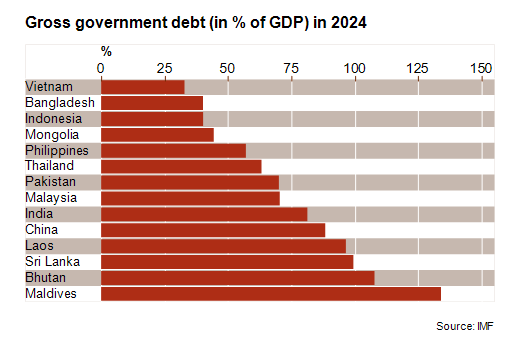
Strong economic performances and disciplined government policies have improved macroeconomic fundamentals over time. Indeed, in 2024, Vietnam displayed manageable public finances with a public debt at 33% of GDP for the year – a healthy level compared to Asian peers – and a low fiscal deficit at 1.6% of GDP, contained inflation at around 3% and a sound balance of payments supported by a current account surplus (6% of GDP) and large inward FDI.
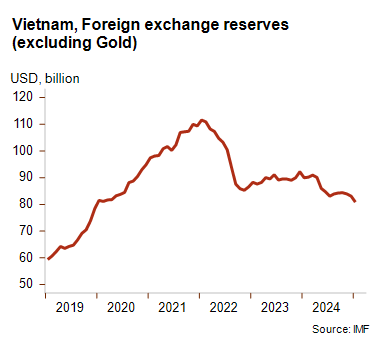
This said, despite solid external accounts, the State Bank of Vietnam’s interventions to limit the dong’s depreciating trend partly continue to keep foreign exchange reserves under the adequate level of three months of import cover, which is why Vietnam is still not in the best category (2/7 with a negative outlook) for short-term political risk, which assesses the country’s liquidity.
The MLT political risk rating is moderate at 4/7, supported by low external debt and debt service, strong economic performances, the still-high GDP growth potential – considering high savings and investment rates above 30% of GDP – and also continued domestic political stability. On the weaker side, Vietnam displays moderate governance indicators with an elevated corruption perception and is highly exposed to natural disasters.
Vietnam: an economic model vulnerable to the US trade war
However, some of the foundations behind Vietnam’s economic success and its economic model more generally both risk becoming unsettled in a turbulent global trade, economic and geopolitical environment. The trade turmoil, driven by the sudden and high US import tariffs hitting hard countries with which the US runs trade deficits, will definitely harm Vietnam’s exports and thus real GDP growth, directly and indirectly. The direct impact will come from US import tariffs, first announced at an astronomic 46% rate for Vietnam1, justified by the US administration as the third largest trade deficit that the US has, is with Vietnam. Since Trump’s first trade restrictions against China were implemented in 2018, Vietnam has definitely been a major winner, being a favourite destination for Chinese exports redirected to the US. Given the high importance of the US market for Vietnam’s exports of goods, namely more than 25% of the total, only second to Cambodia in Asia, the economic threat is high. Bilateral trade negotiations, although they currently look less urgent given the suspension of US import tariffs at the end of May, are expected to reduce the final tariff thanks to various concessions aimed at cutting trade imbalances, including higher purchases of US goods (notably agriculture and LNG) and slashed tariffs on imported US goods. Moreover, the Vietnamese authorities have pledged to fight against trade circumvention, as several foreign companies have been reported as bypassing US tariffs through false certificates of origin. In any case, the US administration’s intended crackdown against the trans-shipment of Chinese goods should keep Vietnam under the US radar during Trump’s second mandate, even in spite of their security cooperation. However, since the higher tariffs announced in early April, the sharp increase of Chinese exports to Vietnam – targeting the US market – highlights that past practices could show resilience as long as possible.
Therefore, attracting FDI and imports of Chinese goods aimed for re-export with a higher added-value will become more difficult in the future, shaking Vietnam’s strengths. The pressures from heightened US import tariffs don’t stop at countries, as certain sectors have also been targeted. Further direct impacts will hit Vietnam, especially the 50% US import tariff on steel and prohibitive rates (between 120% and 813%) on solar panels and components (for alleged dumping): two sectors of importance for Vietnam. The virtual closure of the US solar panel market and higher US import tariffs more generally mean that Vietnam will have to redirect its exports to other markets to the extent possible.
Besides direct impacts, Vietnam’s very open economy will be harmed indirectly by weakening global trade, FDI and a slowing Chinese economy. More uncertainty will cloud prospects in 2025 and 2026, and the country is likely to be hit negatively by the global economic slowdown, high US trade tariffs and stricter restrictions against re-exports from Vietnam. Last April, the IMF predicted a GDP deceleration from 7.1% in 2024 to 5.2% this year, and then to 4% in 2026.
The country’s strategic position in US-China supply chains is under threat
In the new world order, amid the US-China rivalry and geoeconomic fragmentation, Vietnam’s manufacturing and assembly hub looks very uncomfortable between its two top trade partners. Nearly half of Vietnam’s exports go to the US and China, whereas the latter supplies half of Vietnam’s imports, including commodities and inputs for industries such as electronic components. Moreover, these things are both the source of major direct investments. Vietnam’s role in supply chains has grown so much that trade and economic policy choices could become increasingly difficult to make, as Hanoi refuses to take sides. And there is a risk that Trump will urge Vietnam – and other countries in Asia – to reduce its economic ties with China. However, this would be an unlikely concession, as both communist parties have close links, China’s economy is the regional growth engine and most Chinese investments in Vietnam aim to re-export goods to the US. Given its elevated exposure to Chinese and US investments, Hanoi will strive to stick to “bamboo diplomacy”, whereby neutrality in foreign policy brings benefits from both sides. Meanwhile, in order to reduce its high economic reliance, one solution could be to boost intraregional trade, which is already advanced in South-East Asia, as well as bilateral trade with other partners, first within Asia, while eventually reducing exposure to the US market. Moreover, the active search for new free trade agreements, in addition to the many existing ones such as the Asia-Pacific Regional Comprehensive Economic Partnership, is certainly likely to continue in the coming years. For sure, the future risk level for the Vietnamese economy looks to be on a bumpy road for the years to come.
Analyst: Raphaël Cecchi – r.cecchi@credendo.com
1 On 28 May, the US Court of International Trade ruled that US reciprocal tariffs were illegal, before the decision was suspended by a US federal court appeal. The ruling will temporarily hinder part of the US trade war – increased US import tariffs on sectors are unaffected by the ruling – and delay the imposition of high US import tariffs on countries.