
Mexico: Walking a tightrope under mounting US pressure

Highlights
- President Sheinbaum has largely succeeded in balancing relations with the USA and China, despite intensifying geopolitical rivalry.
- The US refusal to extend the USMCA has increased uncertainty, which could weigh on exports, investment and economic growth despite the agreement remaining in force until 2036.
- Public debt has risen to its highest level in more than three decades, although sustainability risks remain contained for now.
- Significant critical mineral reserves could strengthen Mexico’s strategic importance to the USA, which is seeking to diversify supply chains away from China.
- Climate-related risks, including a potential Super El Niño, pose growing threats amid climate change.
Pros
Cons
Head of State and Government
Population
Per capita income
Income group
Main export products
Security conditions appear to have improved
President Claudia Sheinbaum is approaching the midpoint of her six-year term, although the pace and breadth of developments in the past two years may have made it seem longer. Despite an increasingly confrontational US administration, Sheinbaum has largely succeeded in walking the tightrope between relatively constructive relations with the USA, the incumbent superpower and Mexico’s largest export market, and with the USA’s main geopolitical rival, China, a key supplier of Mexican manufactured inputs. Her cool-headed, pragmatic approach to President Trump and sensitivity to US concerns about supply-chain resilience, including through higher tariffs on Chinese imports, have helped to contain bilateral tensions. She has also abandoned her predecessor’s “hugs, not bullets” approach in favour of a more direct and forceful security strategy in order to combat drug trafficking (a major US election concern). As a result, security conditions appear to have improved recently in Mexico, with homicide rates declining, but these security gains may prove fragile, as deep-rooted challenges such as corruption remain unresolved.
USMCA trade negotiations hang over economic growth
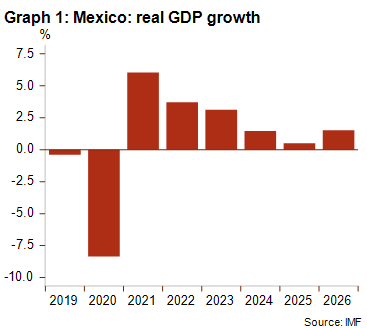
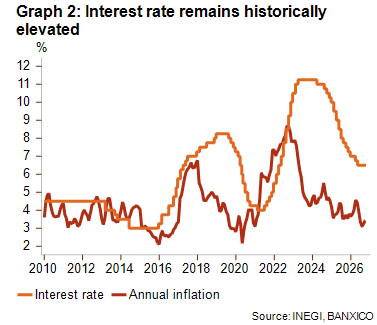
Since July, bilateral relations have deteriorated after the USA unsurprisingly declined to extend the USMCA for a further 16 years. As a consequence, existing USMCA rules shall remain in place for another decade, provided that no country exits the agreement. Mexican exports that comply with the USMCA deal – accounting for roughly 90% of its exports to the USA – still enter the US economy tariff free, although the major change is that the USMCA is now subject to annual review, increasing uncertainty for Mexican businesses and investors. Moreover, if renewal talks remain unsuccessful, the agreement will in any case expire in 2036, meaning that Trump has little incentive to rush into a new deal: the current ambiguity allows him to apply maximum leverage against both Mexico and Canada, which in turn helps the USA to secure concessions (on migration enforcement, for example). Trump may still seek to renew the USMCA before leaving office, particularly given his desired image as the nation’s skilled dealmaker and the fact that he negotiated the original agreement during his first term. That said, as long as the USMCA renegotiation process is ongoing, it will weigh on Mexican exports and delay investment decisions and economic growth in general. This comes on top of Mexico’s already poor economic growth record in recent years (graph 1), while the ongoing Middle Eastern conflict is also likely to weigh on economic activity this year through higher fuel prices (Mexico has been a net fuel importer since 2015) and through higher inflation and a consequently tight monetary policy (graph 2).
Critical minerals might strengthen US relations
Like many Latin American countries, Mexico holds significant mineral deposits necessary for the green energy transition: it is the world’s largest silver producer, a top 10 copper producer, a major zinc producer and a leading producer of fluorspar (critical for fluorochemicals and steelmaking). Mexico also holds the world’s ninth-largest lithium reserves, although commercial development remains limited after a 2022 reform nationalised lithium resources. As the USA looks to counterbalance Chinese dominance in critical mineral supply chains, Mexico’s underdeveloped resources offer considerable long-term growth potential and an opportunity to deepen bilateral economic ties.
Public debt reaches a historic high
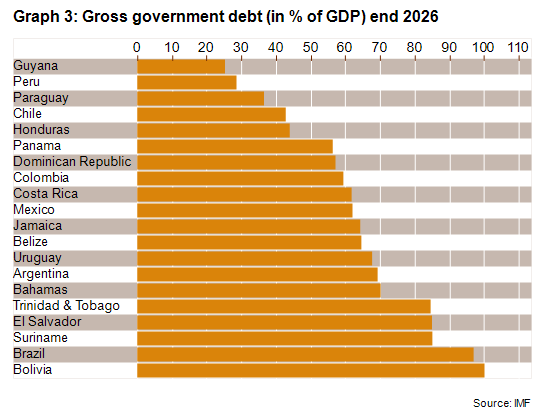
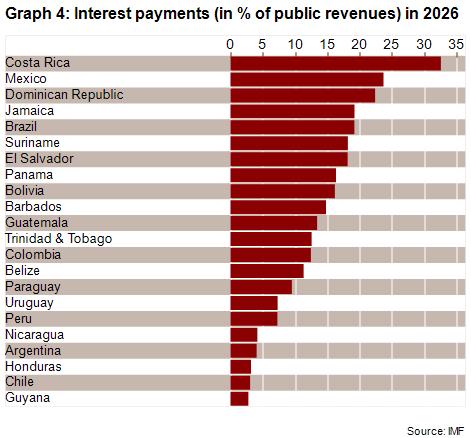
In 2024, when Sheinbaum succeeded her left-wing predecessor and mentor, Andrés Manuel López Obrador, the fiscal deficit reached 5.8% of GDP – its widest level in almost 40 years – amid major infrastructure spending. Since then, the deficit has gradually narrowed and is expected to reach 4.4% of GDP this year. However, with economic growth averaging only around 1% since 2024, public debt has risen from an already elevated 59% of GDP in 2024 to an estimated 63% by year-end 2026. Although this remains manageable and below the Latin American average (graph 3), it is Mexico’s highest level in more than three decades. Interest payments are also elevated, absorbing almost a quarter of public revenue, a high proportion by Latin American standards (graph 4). Additionally, in May, Moody’s downgraded Mexican sovereign debt to one notch above speculative grade. That said, Mexico’s sovereign debt remains at investment grade and IMF projections forecast that public debt will stabilise at an elevated but sustainable level of around 63% of GDP over the coming years, as fiscal consolidation proceeds gradually. However, this outlook might prove to be optimistic: the IMF’s projections assume economic growth of around 2% in the coming years, almost double the average annual rate of only 1.2% recorded between 2015 and 2025. At the same time, the composition of public expenditure leaves limited room for adjustment: besides elevated interest payments, pensions and social transfers account for almost one third of public spending, while oil state giant Pemex continues to impose a sizeable fiscal burden. Meaningful consolidation will therefore be difficult in political terms, especially ahead of next year’s midterm elections.
Upcoming Super El Niño likely to cause severe droughts
Climate change has worsened droughts and associated water shortages, in particular across Central America during the El Niño years. An emerging Super El Niño projected for the end of this year could therefore cause severe water stress in Mexico, disrupting both food production, which accounts for around 6% of current-account receipts, and manufacturing, which generates roughly two thirds of current account revenues. Water scarcity is already a growing concern for businesses, as Mexico remains one of the most water-stressed countries in Latin America. In recent years, authorities have pressured large industrial water users, including beverage companies, to reduce consumption and contribute to local water-supply solutions in drought-affected regions, but the planned expansion of water-intensive industries, including AI data centres and less advanced semiconductor manufacturing, could further exacerbate pressure on Mexico’s strained resources, particularly in drought-prone industrial regions. In addition, tropical storms are also becoming more extreme due to climate change and are regularly hitting Mexico’s coastal areas, affecting communities, infrastructure and businesses.
A negative outlook for MLT political risk amid deteriorating institutional quality
Credendo has classified Mexico under short-term political risk category 2/7, with a stable outlook. The country enjoys a low level of external short-term debt, while foreign exchange reserves are adequate. The medium- to long-term political risk is classified as category 3/7, reflecting Mexico’s sustainable external debt and debt service ratios, small current account deficits, sound public finances and economic diversification, despite its great reliance on the US economy. It has a negative outlook, depending on how far US trade policies will go and the degree of deterioration of Mexico’s institutional quality.
Analyst: Jolyn Debuysscher – j.Debuysscher@credendo.com