
Saudi Arabia: Regional security risks weigh on the economic outlook

The renewed conflict with the Houthis, alongside risks of escalation between the US/Israel and Iran, is putting pressure on key pillars of Saudi Arabia’s economic model amid increasing logistics and security challenges.
Rising security risks
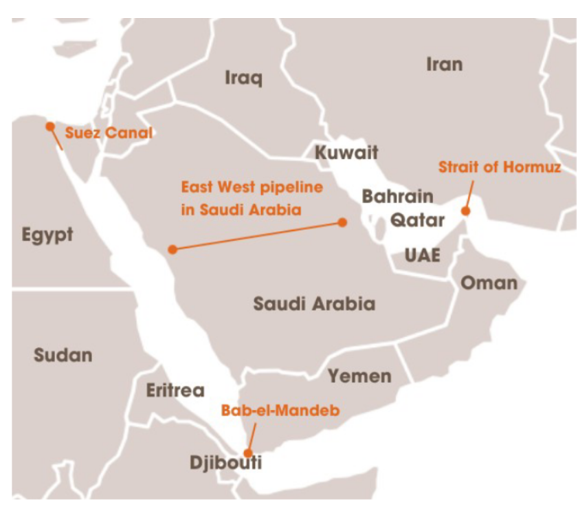
Over recent weeks, the Iran-backed Yemeni rebels, the Houthis, who are fighting the Saudi-backed forces of Yemen’s internationally recognised government (IRG), have intensified attacks on Saudi Arabia. They have targeted energy facilities and other critical infrastructure, most notably King Khalid International Airport in Riyadh. These attacks have heightened security risks in the country and caused several civilian casualties. Moreover, since July, the Houthis have been maintaining a blockade of Saudi ports on the Red Sea and have continued to threaten shipping around the Bab el-Mandeb Strait, a strategic maritime route that Saudi Arabia has relied on to bypass the Strait of Hormuz. At the same time, increasing Iranian attacks in the Persian Gulf could put pressure on the ship-to-ship transfer strategy in the Strait of Hormuz. Together, these developments could jeopardise Saudi Arabia’s mitigation strategies to maintain its oil exports at a time when regional oil outflows are reportedly reaching pre-war levels.
Economic fallout is spreading
Even before the latest deterioration in security conditions, the conflict was already having a considerable impact on the Saudi economy. Real GDP contracted by 4.7% and 3.8% in the second quarter and third quarter of 2026 respectively, driven primarily by the weakness of the hydrocarbon sector. Given the sector’s importance for fiscal and current account revenues, fiscal and external pressures have intensified, compounded by increased government spending to support the economy. As such, fiscal and current account deficits are projected at 6.5% and 3.5% of GDP respectively this year. Looking ahead, sustained attacks on critical energy assets, such as the September attack on the East-West pipeline (Petroline), together with persistent security risks along key maritime trade routes, could further increase risks and operating costs in the hydrocarbon sector.
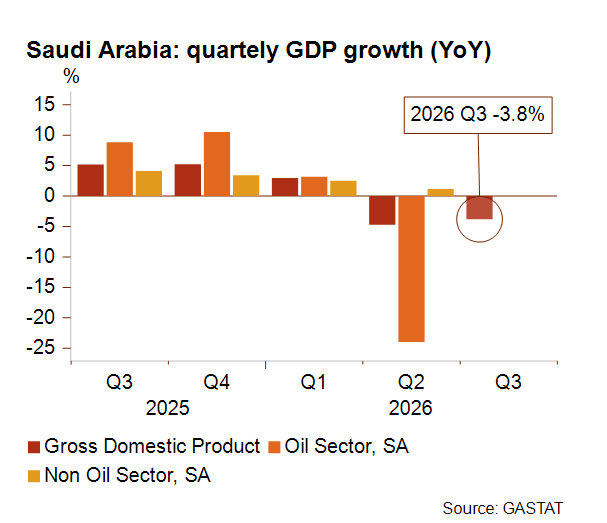
Meanwhile, the non-hydrocarbon sector, which was relatively resilient so far, is now also facing substantial pressure. Heightened security risks and airspace disruptions are affecting the broader economy, particularly sectors targeted by Saudi Arabia’s diversification strategy, including tourism, logistics and hospitality. The postponement and cancellation of several flagship events, ranging from major sporting competitions to investment forums, illustrate this pressure, while persistent uncertainty and heightened security risks could also weigh on investor confidence, with potential implications for the Kingdom’s diversification agenda.
Looking ahead, the outlook will depend heavily on the developments in the US/Israel-Iran war and in the civil war in Yemen. An escalation of hostilities, in particular between the US/Israel and Iran, would further deteriorate regional security conditions and could expose Saudi Arabia to attacks on multiple fronts. Iran and its regional proxies, particularly Iraqi militias, could join the Houthis in attacking the Kingdom, placing additional pressure on its defence capabilities. Conversely, a durable easing of tensions with the Houthis and between the US/Israel and Iran would reduce security and economic risks.
In summary, Saudi Arabia has so far proved more resilient than most GCC peers. Indeed, infrastructure allowing a significant share of oil exports to be redirected to the Red Sea has helped cushion the impact of shipping disruption in the Strait of Hormuz. Moreover, the Kingdom’s moderate debt levels, large foreign exchange reserves and sovereign wealth assets provide ample macroeconomic buffers to absorb a temporary shock. Nevertheless, challenges are mounting rapidly. The conflict is increasingly affecting Saudi Arabia’s economic model and could slow its diversification agenda, with consequences that could extend well beyond the short term.
Analyst: Andres Hernandez Cardona - a.hernandezcardona@credendo.com