
United States: Global implications of a sharp increase in US Treasury yields

Event
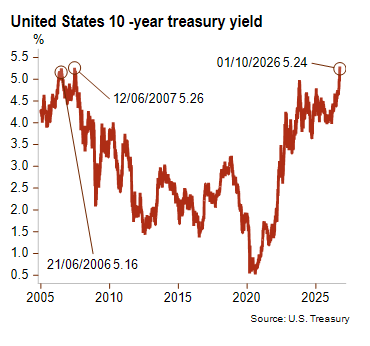
Long-term US Treasury yields have risen sharply recently, bringing the 10-year yield close to the 20-year peak observed in June 2007 (see graph).
What are the drivers of high yields?
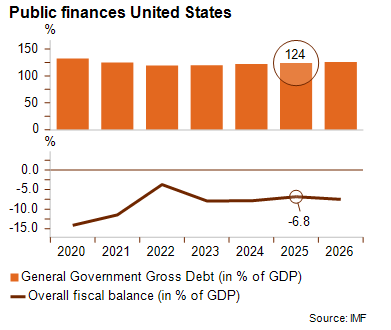
The sharp increase in long-term US bond yields is being driven by a combination of macroeconomic and market factors. First, the persistent deterioration of US public finances, coupled with higher inflation expectations stemming from higher energy prices and ongoing tensions in the Middle East, has contributed to upward pressure on yields. In addition, the resilience of US economic growth has reinforced expectations that US interest rates could remain higher for longer.
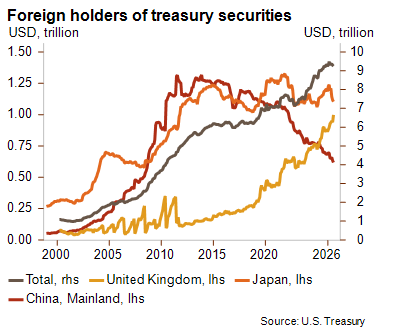
Supply and demand dynamics have also played an important role. On the supply side, Treasury issuance has increased in response to large fiscal deficits and the continued rise in public debt. On the demand side, strong investment in artificial intelligence and related technologies has attracted substantial amounts of capital, reducing demand for government bonds and putting upward pressure on yields. Moreover, whereas foreign holdings of US Treasuries continue to increase in absolute terms (see graph), geopolitical developments have changed their composition. China has gradually reduced its holdings of US government bonds (see graph), while tensions in the Middle East might affect the external surpluses of some Gulf states, potentially limiting their capacity to invest abroad. At the same time, Japan, the largest foreign holder of US Treasuries, has intervened in the foreign exchange market to support the yen, contributing to a decline in its holdings of US Treasuries in recent months.
What are the global implications of rising US Treasury yields?
Rising US Treasury yields have a direct fiscal impact by increasing the cost of issuing new government debt, thereby reducing fiscal space and raising US debt-servicing costs. However, this challenge extends beyond the United States. Many major economies face high public debt levels (see G20 public debt graph) and, in some cases, rising long-term interest rates. This combination undermines long-term growth prospects and governments’ ability to absorb shocks. The risks associated with this situation should not be overlooked. Unlike during the 2008 global financial crisis, public debt burdens are now substantially higher across most advanced and emerging economies. Consequently, governments may have less scope to introduce fiscal support measures on the scale seen in the USA, the EU, China and Japan during and after the crisis.
Given that the US Treasury market is the world’s largest and most influential bond market, changes in US bond yields have significant global repercussions. Persistently elevated interest rates are expected to weigh most heavily on capital-intensive sectors. These include construction, notably large-scale infrastructure projects and data centre investments linked to the expansion of artificial intelligence, as well as consumer-durable industries such as automotive and furniture manufacturing. Infrastructure-related industries, including energy and telecommunications, are also likely to face increased pressure, as are sectors with substantial financing needs such as airlines and highly indebted obligors.
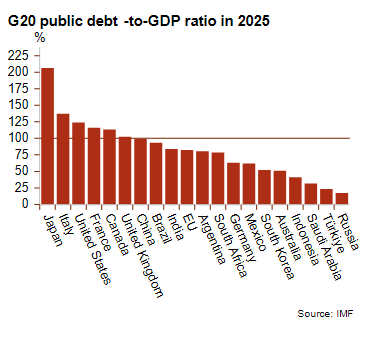
Higher long-term yields in advanced economies are also likely to generate spillover effects elsewhere. In this regard, it is worth noting that global financial conditions have remained relatively favourable so far and no significant capital outflows from emerging markets have been observed to date. Emerging-market bond markets have remained resilient, with no sharp increase in spreads over US Treasuries. On the contrary, spreads remain low by historical standards. This resilience can be partly explained by the fact that, while some countries, particularly low-income economies, continue to face significant fiscal vulnerabilities, many emerging markets have stronger public debt positions than advanced economies (see G20 debt chart). Furthermore, many emerging economies have adopted more orthodox fiscal and monetary policies over the past decades, which has strengthened macroeconomic stability and improved investors’ risk perception.
Nevertheless, the risk of financial contagion should not be underestimated. Capital outflows from emerging markets could be triggered by the prospect of higher risk-adjusted returns in advanced economies, particularly if long-term yields continue to rise. In addition, higher interest rates could weigh on global equity markets, leading to a broader tightening of financial conditions worldwide.
History shows that periods of high and rising interest rates tend to amplify debt vulnerabilities, especially among highly indebted borrowers. This risk is particularly significant in today’s environment, which is characterised by elevated levels of global indebtedness.
Analyst: Pascaline della Faille - P.dellaFaille@credendo.com