
Azerbaijan: Geopolitical tensions bring both risks and opportunities

Event
Geopolitical tensions are reshaping Azerbaijan’s geoeconomic position. Following Russia’s invasion of Ukraine, Europe has intensified its efforts to diversify its energy supplies and trade routes, increasing Azerbaijan’s importance as both an energy supplier and a transit country. These developments create significant economic opportunities, although regional instability continues to expose the country to security risks.
Impact
Instability in the Middle East has further highlighted the value of alternative transport corridors. The rerouting of international air traffic through a narrow corridor across the South Caucasus following disruptions to Iranian airspace illustrated the region’s growing strategic relevance. Azerbaijan is seeking to capitalise on these developments by expanding its transport and logistics sectors, with freight volumes and transport-related revenues already on the rise. The country occupies a central position along the Middle Corridor, which has gained importance as trade flows have shifted away from the Northern Corridor following the imposition of Western sanctions on Russia. Improved relations with Armenia and the proposed Trump Route for International Peace and Prosperity (TRIPP) could provide an additional boost to regional connectivity.
However, Azerbaijan’s regional ambitions continue to face geopolitical and implementation risks. While relations with Armenia have improved significantly and the outline of a peace agreement has been agreed, the deal still requires constitutional changes and formal approval in Armenia, leaving some uncertainty over its eventual implementation. Relations with Iran remain pragmatic but are still marked by underlying mistrust, particularly regarding Azerbaijan’s close relationship with Israel and disagreements over regional transport corridors. The drone strike on Azerbaijan’s Nakhchivan exclave in March 2026 highlighted the risk that wider regional tensions could spill over into the South Caucasus and affect strategically important transport and energy infrastructure, though this is not the most likely scenario.
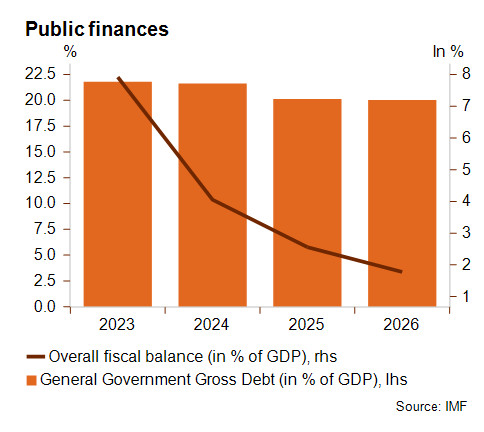
Azerbaijan’s macroeconomic fundamentals remain strong, supported by low public debt (see graph below), sizeable foreign exchange reserves equivalent to around five months of imports and substantial assets accumulated in the State Oil Fund of the Republic of Azerbaijan (SOFAZ).
Nonetheless, the economy remains highly dependent on hydrocarbons, which continue to account for the bulk of export earnings and fiscal revenues. While natural gas exports have gained importance in recent years, oil production has been declining since its 2010 peak, highlighting the need for broader sources of growth. Efforts to diversify the economy beyond hydrocarbons have intensified, including through investments in renewable energy, logistics, manufacturing and non-oil services. However, these sectors remain relatively small and have yet to meaningfully reduce the economy’s dependence on the energy sector.
Credendo’s political risk ratings for Azerbaijan remain unchanged, with the short-term political risk rating at 3/7 and the medium- to long-term political risk rating at 4/7. The ratings are supported by Azerbaijan’s low public and external debt, sizeable foreign exchange reserves and substantial sovereign wealth fund assets. While Azerbaijan stands to benefit from rising energy prices and its growing role as a regional transit hub, notably through initiatives such as TRIPP and the Middle Corridor, these opportunities remain exposed to geopolitical risks and constrained by institutional weaknesses. At the same time, limited economic diversification and continued reliance on hydrocarbon revenues leave Azerbaijan vulnerable to fluctuations in global oil and gas prices.
Analyst: Jonathan Schotte – j.schotte@credendo.com