
Argentina: MLT political risk upgraded to category 6/7

Highlights
- Milei has largely stabilised the economy, with inflation declining sharply and economic growth rebounding.
- Solvency indicators – key to medium-to-long-term political risk – have improved markedly due to debt restructuring and fiscal consolidation.
- The IMF has been a key anchor for financing current account deficits in recent years, but FDI is expected to assume this role from this year onwards.
- Liquidity remains a key vulnerability, as net foreign reserves remain deeply negative.
- A return to Peronism and unorthodox policies after the presidential elections of 2027 is still a major risk.
Pros
Cons
Head of State and Government
Population
Per capita income
Income group
Main export products
An economy largely stabilised thanks to President Milei
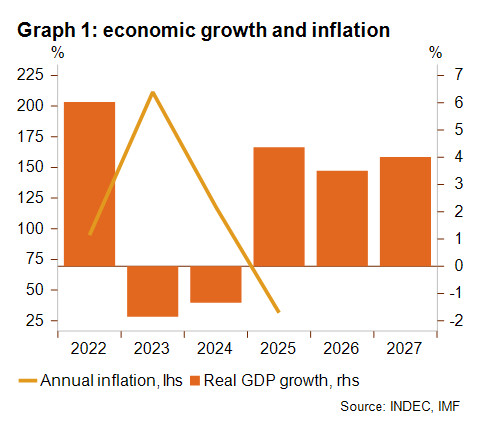
Neoliberal President Javier Milei took office two years ago, after yet another unorthodox Peronist administration that had pushed the economy to the brink of collapse, derailed the IMF programme and triggered a currency crisis. Since then, Milei has managed to keep the economy largely stable. Inflation has fallen sharply from a peak of 211% at year-end 2023 to 32% at year-end 2025, although it remains in double digits. Disinflation is expected to continue gradually, with its pace partly contingent on global oil prices and food prices, particularly if the fragile peace truce between Iran and the United States does not hold and depending on the intensity of the upcoming potential “monster” El Nino. Economic activity has also rebounded strongly. After two consecutive years of recession (averaging -1.6% in 2023–2024), real GDP grew by a robust 4.4% in 2025 and is projected to expand by 3.5% this year. Upside risks to growth remain, in the light of Argentina’s position as a net fuel exporter since 2023, and the direct impact of the prolonged disruption in the Strait of Hormuz is limited, given Argentina’s low trade exposure to the Gulf region (around 1% of imports and 2% of exports).
Fiscal turnaround implemented by Milei, but vulnerabilities linger
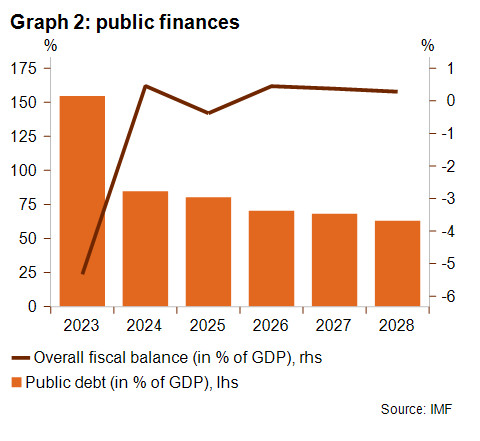
Milei’s biggest accomplishments are on the fiscal front: he has implemented the largest fiscal consolidation in more than three decades, restoring primary surpluses from 2024 onwards – the first time since 2008. This adjustment, anchored by the first IMF programme completed successfully in a decade, drove a sharp decline in public debt from an unsustainable 155% of GDP at year-end 2023 to a still high but more manageable 80% of GDP by year-end 2025. Looking ahead, Milei’s party’s strong performance in the November 2025 midterm elections creates the political space required to advance further necessary fiscal reforms. Public debt is expected to fall to an albeit-still-elevated level of 71% of GDP by 2027, helping to safeguard the IMF programme. The IMF assesses Argentina’s public debt as sustainable, but with no high probability that this will remain the case, as the baseline scenario hinges on strict fiscal consolidation and stable access to the financial markets to repay large external financing needs in the coming years. This baseline remains vulnerable to downside risks. Fiscal slippages, particularly in the run-up to the pivotal 2027 presidential elections, remain a key risk, especially amid signs of declining public support for Milei. While sovereign creditworthiness has improved – with Argentina upgraded from the highly distressed “CCC” category to “B‑” by Fitch and S&P in May and June this year respectively – and market access has resumed, this remains fragile. Sovereign ratings are still deeply speculative and well below investment grade, with Moody’s maintaining a lower rating of Caa1. As such, preserving the recent gains in market access will be challenging, especially given Argentina’s high exposure to shifts in global financial conditions stemming from its history of economic mismanagement, recurrent balance-of-payments crises and serial sovereign defaults. Lastly, a potential enforcement of the suspended lawsuit against state-owned energy company YPF (for about 2.5% of GDP) remains an important contingent liability.
The IMF is a key anchor for financing current account deficits, but FDI is expected to assume this role
External performance is more mixed. Milei unwound most of the distortive foreign exchange restrictions and implemented a large devaluation, but stopped short of floating the exchange rate. As a result, the current account swung from a wide deficit of -3% of GDP in 2023 to a small surplus of 1% of GDP in 2024 amid import compression due to the recession. However, as domestic demand recovered and the exchange rate became increasingly overvalued, the balance moved back into a moderate deficit of -1.3% of GDP in 2025. This year, a small deficit of -0.9% of GDP is forecast, but higher oil and grain prices could positively surprise the current account revenues. With limited access to international capital markets, the IMF has remained the primary source of external financing in recent years, and looking ahead, small but gradually declining current account deficits are expected, mainly driven by rising exports. Several factors underpin this outlook. Firstly, a gradual move toward a more flexible exchange rate is anticipated, although a fully floating regime, long advocated by the IMF, still lacks a clear timeline, with multiple exchange rates and restrictions remaining in place. Secondly, new trade agreements are set to support exports. The 2026 trade deal with the USA removes tariffs on a broad range of goods, although strategic tariffs (such as the 50% levies on steel and aluminium) remain. In addition, the Mercosur-EU agreement, which entered into force on 1 May this year, will progressively liberalise trade over a 15-year transition period. Thirdly, Argentina’s vast natural resource base, particularly in lithium and energy, offers strong export potential. These positive dynamics are expected to partly offset rising factor service outflows, driven by the easing of restrictions on profit repatriation and higher interest payments. In addition, financing patterns are expected to shift. Foreign direct investment (FDI), supported by last year’s electoral outcome, is anticipated to gradually replace the IMF as the primary source of external financing from 2026 onwards, although this transition will depend on maintaining macroeconomic stability and investor confidence.
Better solvency, but persistent external liquidity fragility poses a risk for another currency run
Solvency indicators have improved markedly. Because they are key to the medium-to-long-term political risk, Credendo has therefore decided to upgrade the country to category 6/7. Supported by fiscal consolidation and debt restructuring, external debt has fallen to more sustainable levels and the financial risk has been partly mitigated by the debt profile, with around 80% of external debt at medium-to-long maturities – although this also reflects limited market access and reliance on official creditors, which account for roughly one third of total external debt. Short-term external debt has declined but remains elevated, while debt service ratios are also trending downwards. Going forward, external debt and debt service ratios are expected to remain broadly stable.
That said, Argentina’s external liquidity position – its longstanding Achilles’ heel – remains weak. Despite gross foreign exchange reserves having tripled over the past three years, liquidity remains limited at around two and a half months of import cover. Moreover, net foreign reserves (excluding undrawn swap lines which are usually not taken into account in FX reserves) remain deeply negative, standing at -USD 10 billion in April 2026, only slightly improved from -USD 11.2 billion at end 2023. The managed and overvalued currency band is constraining reserves accumulation, while a currency run during mid-term elections in 2025 quickly eroded foreign exchange gains and was only halted through an unprecedented USD 20 billion swap line from the US Treasury. As a result, Argentina remains vulnerable to renewed currency pressures, consistent with its history of repeated currency runs, most recently in 2013, 2014, 2018, 2019, 2020, 2023 and 2025. Looking forwards, foreign exchange reserves are expected to strengthen thanks to stronger FDI inflows, but net reserves are forecast to remain negative until at least 2027.
A return to Peronism after the presidential elections in 2027 could trigger another currency run
Structural vulnerabilities remain significant. Institutional indicators are still weak, while climate shocks – and in particular droughts, given agriculture’s historical share of around 45% of current account revenues – can materially weaken export revenues and affect liquidity. In this context, a potential “monster” El Nino in the coming months poses a real risk, with the potential to destroy harvests through flooding. Reliance on external support increases the country’s risk further: the crucial US swap line is not unconditional; in fact, its terms are opaque and may hinge on Argentina distancing itself from China (Argentina’s biggest trade partner and an important creditor), Milei’s political stability (while unrest is likely to rise) and reform credibility. At the same time, the IMF’s position as Argentina’s biggest lender gives it very high exposure and raises questions about its capacity to act as a lender of last resort in a future balance-of-payments crisis. Political uncertainty remains a key risk, reflecting Argentina’s history of cyclical policy reversals. Since the return to democracy in 1983, Peronism has repeatedly returned to power (1989–1999, 2002–2015, 2019–2023), raising the risk that history could repeat itself. The 2018 episode in particular illustrates this dynamic: doubts about centrist President Macri’s electoral prospects acted as a catalyst for a currency run that triggered an inflation spike and a recession, which ultimately paved the way for a return of Peronism by the end of 2019. Similar risks are emerging ahead of next year’s elections, in which negative polling for Milei could quickly trigger market panic (especially given the persistent corruption scandals in his administration), and potentially reignite a currency run and the quick depletion of gross foreign exchange reserves. The ensuing instability could worsen Milei’s polls, setting off a damaging self-fulfilling prophecy. While recent policy improvements suggest scope to break with past cycles, the question remains: will history repeat itself?
Analyst: Jolyn Debuysscher – J.Debuysscher@credendo.com