
Brazil: Lula defies the odds to secure an unprecedented fourth presidential term but fiscal challenges loom

Event
Luiz Inácio Lula da Silva unexpectedly won Brazil’s presidential election. The left-wing incumbent secured almost 52% of the vote, compared with 48% for his right-wing rival Flávio Bolsonaro, a son of former President Jair Bolsonaro (2019–2023). Bolsonaro conceded defeat, unlike his father in 2022, when the disputed election result was followed by violent unrest. The victory is a remarkable turnaround for Lula, who lost the first-round ballot to Bolsonaro. No presidential candidate since Brazil’s return to democracy in 1985 had lost the first round and subsequently won the run-off. Lula will now serve a fourth term, an unprecedented feat for a democratically elected president in Brazil and a relatively rare occurrence globally, particularly in large democracies with powerful executive presidents. Moreover, Lula’s victory interrupts a recent rightward electoral trend in Latin America after a succession of right-wing and centre-right victories across the region.
Impact
Despite his win, Lula will enter his fourth term from a weaker political position than during his previous presidencies. In the first round on 4 October, Bolsonaro’s party, Partido Liberal (PL), emerged as the most powerful congressional caucus since Brazil’s constitution was enacted in 1988. Hence, governing will be difficult. That said, Brazilian political parties tend to be interest-based rather than ideologically driven, making pork-barrel spending a commonly used coalition-building technique in Brazil.
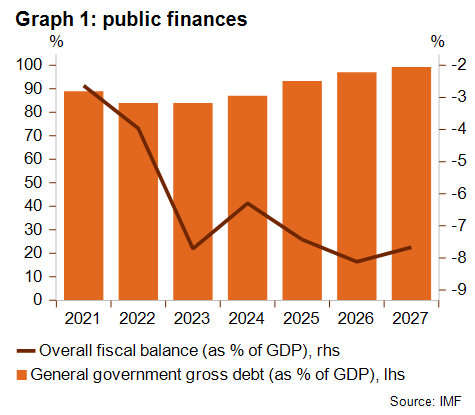
The main challenge, however, is the deterioration in public finances. Under Lula, Brazil’s fiscal position has weakened markedly. Since he took office in 2023, public debt to GDP has increased by around 13 percentage points (graph 1). Much of the pressure on public finances stems from rigid mandatory expenditure set by law, particularly pensions and social security spending, which consume around 90% of budget expenditure. Moreover, in the three weeks between the first and second rounds, Lula offered a series of costly giveaways, including increasing Brazil’s flagship welfare programme by 15%, reducing the working week by one day without pay cuts, making public transport free at weekends and forgiving federal debts for sole traders. Incumbent presidents in Brazil often announce generous spending measures before elections, but even by Brazilian standards, Lula has been particularly generous. Hence, projections for the fiscal deficit (estimated at a sizeable -7.7% of GDP in 2027) and public debt (estimated at a high 99% of GDP) are likely to prove too optimistic if the campaign promises are implemented without compensating fiscal measures. Long-term pressures such as rising climate-related spending and an ageing population will also continue to weigh on Brazil’s fiscal outlook. Looking forward, if Lula does not take measures to rein in public spending significantly, he risks a fiscal credibility crisis.
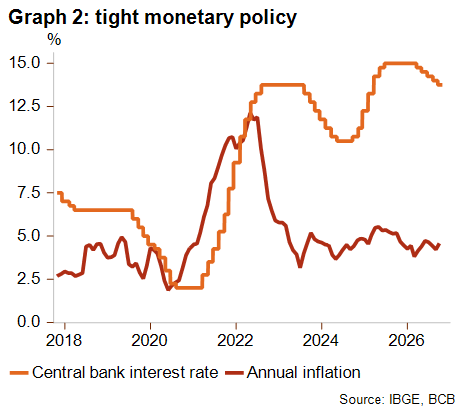
The expansionary fiscal policies also weigh on the economic outlook. The central bank continues to maintain its policy rate at a high 13.75% (graph 2), reflecting its fight against persistent inflationary pressures, which have been exacerbated by expansionary fiscal policy. High interest rates, however, weigh on economic growth (projected at 2.2% in 2026 and 1.9% in 2027) and the business environment. On the upside, rising commodity prices, expanding oil production, a very strong agribusiness sector and Brazil’s vast reserves of rare earth minerals could provide upward growth momentum, especially as China currently controls most of the global supply.
The MLT political risk rating, upgraded in 2022, has a stable outlook. The country has relatively modest current account deficits, which are mainly financed by FDI, and moderate external debt ratios. However, weakening institutional indicators and public finances are a cause for concern and could turn the outlook negative if they are not addressed. Lula’s victory is likely to keep relations with US President Donald Trump strained, with continued tariff pressure remaining a key risk. Nevertheless, the macroeconomic impact has so far been limited. The short-term political risk rating is in category 2/7 and has a stable outlook, thanks to a large and relatively stable buffer of foreign exchange reserves and manageable short-term external debt levels.
Analyst: Jolyn Debuysscher J. Debuysscher@credendo.com