
Nigeria: Oil windfall and reforms put Nigeria on a stronger footing

Highlights
- Nigeria has been capitalising on high international oil prices and trade rerouting following the conflict in the Gulf.
- The oil windfall, new refining capacity and sustained fiscal and monetary reforms support prospects for growth and macroeconomic stabilisation.
- Chronic insecurity, deficiencies in public finances, heavy debt-servicing pressure and exposure to oil market shocks remain the principal risks.
- Current global conditions have improved prospects for the African giant.
Pros
Cons
Head of State
Electoral system
Population
GDP per capita
Income group
Main export products
Outlook reinforced by oil windfall and refining surge despite deep-rooted challenges
After more than a decade of stagnation, economic growth is projected to balance at around 4% of GDP over the coming years. Although the contribution of non-oil sectors like fintech and agriculture has been rising, economic growth is still highly oil driven. Global energy trade rerouting due to the conflict in the Gulf has been an opportunity for Nigeria, as it has attracted important investments and high oil prices that have substantially boosted export revenues. Meanwhile, the IMF’s World Economic Outlook estimates that the average 2026 oil price shall reach USD 95/barrel by the end of the year, even though Brent crude traded at USD 111/barrel at the end of October and tensions in the Middle- East show no signs of diminishing.
The onset of production at the Dangote refinery has been an absolute gamechanger, sharply decreasing Nigeria’s reliance on imported fuel for domestic consumption. Refined oil is even being exported, with Dangote’s USD 1.6 billion initial public offering (IPO) expected to be the largest ever seen in Africa, which will finance expanding industrialisation. The economic recovery is strongly supported by the oil windfall but is also driven by successful monetary and fiscal reforms, lifting prospects for growth and financial stability.
Despite the enormous potential of the largest economy of Sub-Saharan Africa, important structural weaknesses have been holding Nigeria back for years. Security risks amid multiple conflict zones, corruption at all levels of society, crude oil theft, environmental degradation, high inflation, capital flight, unemployment, unreliable electricity supply and high transport costs are all weaknesses that undermine investments and living conditions.
Sweeping reforms are finally set to restore macroeconomic stability
When President Tinubu came to power in May 2023, he immediately embarked on an ambitious reform programme to revive the economy and attract investments. The impact of the unification of parallel exchange rates and the removal of fuel subsidies was deeply painful for the average Nigerian – the liberalisation of the naira led to a spectacular 70% depreciation against the USD, due to which Nigeria’s GDP and GDP per capita in USD terms more than halved. High inflation and the gradual phasing-out of fuel subsidies also led to a cost-of-living crisis and social unrest.
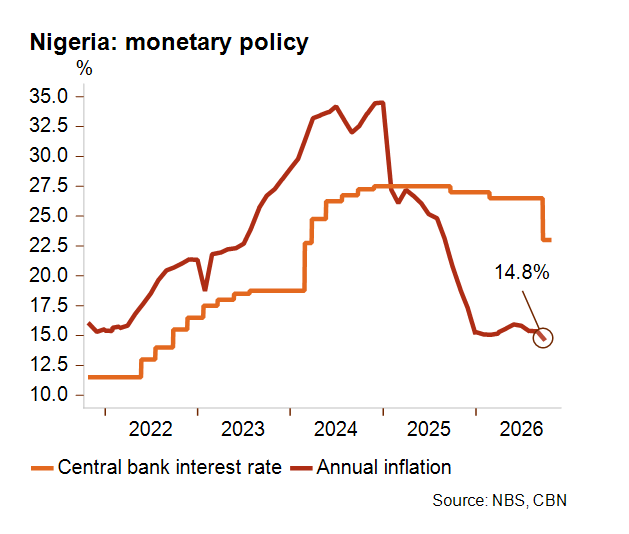
Nigeria’s poverty rate has risen significantly over the past decade, reflecting the higher-than 20% inflation and weak real-income growth, but recent data indicate that this deterioration has been stabilising over this year. Following a statistical rebasing exercise, inflation plunged in December 2024, initiating a downward trajectory supported by the discontinuation of deficit financing by the Central Bank of Nigeria (CBN). Inflation continued its downward path in 2025 and the CBN even introduced its first policy rate cuts in years (see graph above). Nevertheless, inflation still remains a challenge at almost 15%, while the IMF only expects it to drop to 10% by 2029.
Liquidity supported by a strong recovery in foreign exchange reserves
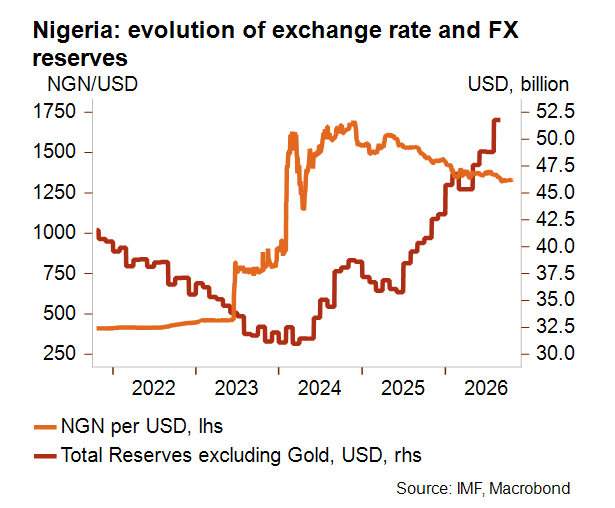
The costly gap between the parallel and official exchange rates has virtually closed and the naira has gained some value again against the US dollar since 2025. The managed float regime for the naira has helped the recovery of foreign exchange reserves thanks to fewer exchange rate interventions by the CBN. The rising level of foreign exchange reserves can also be explained by large external borrowing (such as the November 2025 Eurobond), import substitution measures, lower fuel imports (thanks to the Dangote refinery) and a jump in oil production since 2022, although the long-term trend for crude oil production is still negative. Favourable conditions shifted the current account into a 3% of GDP surplus this year and together with higher portfolio investment inflows pushed foreign exchange reserves towards USD 51 billion in August 2026 (seven months of imports of goods and services).
Structural vulnerabilities within public finances are hard to amend
One of the striking deficiencies in Nigeria’s public finances is its low public revenues. This is the result of a narrow tax base dominated by a large informal economy, weak compliance and tax administration, extensive exemptions and a relatively low effective taxation of consumption. This is compounded by the weak contribution of the oil and gas sector to government revenues due to complex fiscal petroleum arrangements, corruption, oil theft and illegal bunkering, which also causes huge environmental damage and exacerbates insecurity in oil-producing regions. Nigeria’s public revenue-to-GDP ratio barely reached 6% for years – among the lowest in the world – and well below the Sub-Saharan African average of 18% of GDP. However, reforms to the tax system since 2023 helped to raise this ratio to about 10% of GDP by 2025, but this is still very low for a large oil exporter.
The fiscal deficit is expected to reach 4.7% of GDP in 2026 and is projected to be more moderate in subsequent years. The removal of fuel subsidies and lower fuel import requirements have reduced public expenditures while oil-related revenues have thus increased. Nigeria does have a limited public debt stock of 36% of GDP (projected to remain stable), but its public interest and debt servicing burden is substantial in comparison. President Tinubu’s borrowing plan increased the proportion of external debt from a third of the total public debt stock in 2022 to almost half in 2026, exposing Nigeria to exchange rate fluctuations on the one hand, but lowering the sovereign-bank nexus risk on the other. One notable fiscal risk is the historic rise in accrued debts among Nigerian State-Owned Enterprises (SOEs), for which reliable, documented figures are lacking, but an extensive privatisation drive should help to address the contingent liability risk and improve the performance of these companies across all sectors. Consequently, Nigeria’s moderate public debt stock masks a much heavier debt burden when measured against government revenue.
When looking at Nigeria’s general financial position, growing private sector external indebtedness has resulted in a large external debt servicing burden compared to its export revenues, which could pose a risk in the event of a shock, such as a sharp drop in international oil prices.
Nigeria’s insecurity is chronic and shows no signs of improvement
The number of violent events across Nigeria reached record highs in 2026, which represents a growing coup risk due to the military’s inability to deal with these conflicts. The north-east is dominated by Boko Haram and the Islamic State West Africa Province (ISWAP), while Jihadist violence in the tri-border region with Benin and Niger (north-west) is also on the rise and the south-west is becoming increasingly affected too. There is also inter-communal violence between sedentary farmer (mostly Christian) and nomadic herder (mostly Muslim) communities over landownership in the central regions and a low-intensity rebellion in the oil-producing Niger Delta. In terms of climate change, more frequent droughts, floods and land degradation are all reducing agricultural output, while increasing competition over land and water. These pressures may further intensify food insecurity and farmer-herder tensions.
President Bola Tinubu is well positioned to win a second term in the January 2027 presidential election, given the ruling All Progressives Congress (APC) party’s control of most state governments and the divided opposition. Nevertheless, competitive state-level elections could lead to local flare-ups of violent unrest. In terms of socioeconomic tensions, the high cost of living and insecurity set the scene for a sustained risk of disruptive protests and strikes across the country, not forgetting that the concentration of wealth and progress around the city of Lagos alienates most of the rest of the country, which could backfire at some point. This all results in a high risk of political violence, which is factored into the general risk assessment for Nigeria. Credendo classifies Nigeria’s MLT political risk in category 6/7 and short-term political risk in category 5/7, with a cautiously positive outlook.
Analyst: Louise Van Cauwenbergh – l.vancauwenbergh@credendo.com