
India: Resilient real GDP growth amid rising inflation

Event
Against the odds, India’s real GDP growth has so far shown high resilience, comfortably remaining the fastest-growing G20 economy. In its latest forecasts, the IMF expects real GDP growth of 7% in the current financial year, FY2026/27 (ending in March 2027), and in FY2027/28, down from 7.8% in FY2025/26.
Impact
Over the past two years, India has been hit by the US trade war, a brief violent military conflict with Pakistan and the fallout from the Middle East conflict. These three external shocks have harmed the economy through various transmission channels, particularly higher inflation, a widening current account deficit (largely due to costlier energy imports) and a weakening rupee, which has fallen to a historic low despite interventions by the Reserve Bank of India (RBI). The most harmful impact comes from India’s high dependence on energy and fertiliser imports from the Gulf and its broad economic and financial links with the region. Given its limited strategic oil reserves and heavy reliance on fuel imports, which account for close to one-third of total imports and come mainly from the Gulf, the authorities have adopted a mix of mitigating measures. These include reducing energy demand, increasing fuel imports from alternative suppliers, especially Russia, and diversifying energy sources. More recently, oil supplies to India have improved sharply as Gulf countries have used alternative, albeit costlier, trade routes. Still, since June, Delhi has been unable to prevent inflation – which reached 5.5% in September – from rising and fluctuating above the RBI’s 4% target as higher food and oil prices have spilled over into the wider economy. The RBI therefore raised its policy rate to 5.5% for the first time since early 2023, in line with the monetary tightening observed across advanced economies.
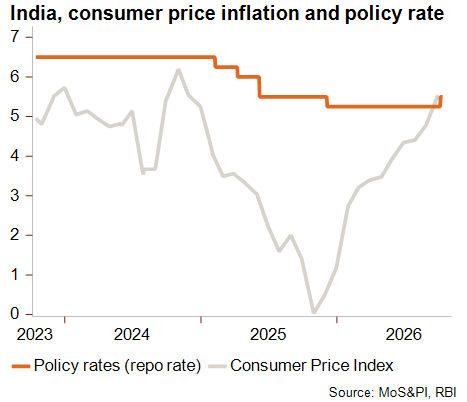
Despite these external shocks, the economy has managed to keep a strong momentum thanks to resilient household consumption, a large domestic market and a well-performing IT services sector. That said, higher inflation, less favourable financial market conditions and a poor monsoon, combined with El Niño, are expected to affect domestic demand and the economy over the next year. The geopolitical context continues to produce mixed outcomes. The US trade war has had only a moderate impact on India’s economy following the trade deal reached in February, which included much lower tariffs on a broad range of Indian exports. However, uncertainty persists as difficult negotiations continue against the backdrop of deteriorated bilateral relations. At the same time, India is benefiting from trade diversion and shifts in global supply chains, as shown by the surge in FDI in the pharmaceutical and electronics sectors, which is helping to offset the impact of the US trade war.
In the coming months, an extended Middle East conflict and oil price shock will represent the dominant downside risks to India’s economic outlook. For the time being, the short-term risk outlook is stable, with a short-term political risk rating in category 2/7, supported by robust foreign exchange reserves, and a business environment risk rating still in category E/G as the rupee remains under depreciation pressure, having fallen by 6% against the US dollar between January and mid-October, while inflation is rising and an economic slowdown is expected.
Analyst: Raphaël Cecchi – r.cecchi@credendo.com