
Asia: Shipping chokepoints face rising geopolitical risks

Event
In the context of a more volatile and uncertain global geopolitical order, maritime chokepoints have become a prominent issue for global trade and the world economy. Recently, the closure of the Strait of Hormuz and the geopolitical power play surrounding the Panama Canal have highlighted the risks and consequences of any disruptions in strategic chokepoints. The fallout from the blockade of the Strait of Hormuz on global fuel supply is sharp and particularly hitting Asia, which relies the most on the Gulf for its energy supplies. Asia itself has several major shipping chokepoints, whose disruption could hit the world economy hard. In the current geopolitical context, where the risks of conflict are rising in Asia amid the China-US rivalry, this risk has become more salient.
Asia is the world’s most dynamic region. It lies at the heart of global supply chains, dominated by China. While the region handles the largest volumes of global trade, Asia displays significant geopolitical and economic vulnerabilities at sea. Regional trade, and more fundamentally global trade of manufactured goods and energy, are exposed to any potential disruptions in the Strait of Malacca, the Taiwan Strait and the Luzon Strait, which are all key shipping lanes. So, in the current context, there is a risk that Iran’s recent weaponisation of the Strait of Hormuz be replicated by countries surrounding those other strategic straits to gain leverage or to secure economic benefits. In fact, an illustration of this risk occurred earlier this year when an Indonesian finance ministry official floated the idea of a potential fee on commercial ships transiting through the Strait of Malacca.
Analysis
The Strait of Malacca, situated on the territorial waters of Malaysia, Singapore and Indonesia, is an international narrow strait linking Asia to Africa, the Middle East and Europe where freedom of navigation is granted to all ships. It handles the largest volume of goods trade (38% in volume in 2023) globally. The Taiwan Strait, separating Taiwan and mainland China, is the second busiest sea trade passage, notably with half of the global container fleet passing through this chokepoint. The Luzon Strait, situated between Taiwan and the Philippines, comes third in importance. None of those natural straits is controlled by any country.
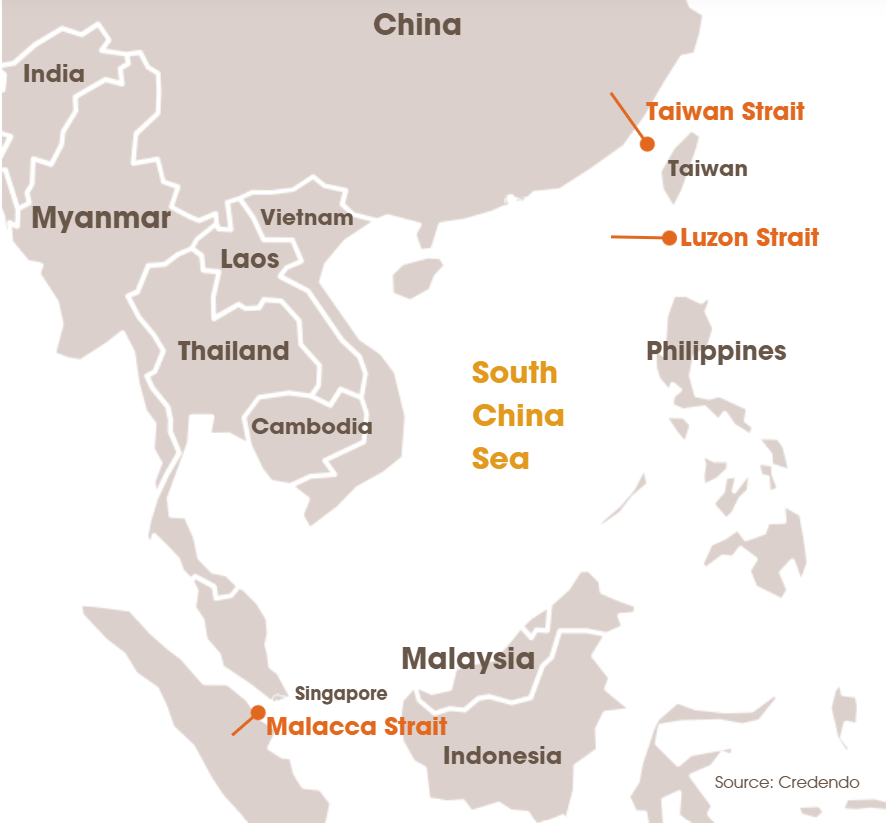
However, in a multipolar world where disruption risks are on the rise, the continuity of those shipping routes is threatened. The biggest risk relates to the rivalry between China and the US. While global maritime order could be questioned – as the latest stances around navigation in the Strait of Hormuz have pointed out –, competition between the two great powers could potentially trigger disruptions in those strategic straits in case of a military conflict. Crucially, China is increasingly showing assertiveness in the disputes around the islands and waters of the South China Sea, whereas the US aims to preserve freedom of navigation. Contrary to the ruling of the United Nations Convention on the Law of the Sea (UNCLOS) arbitral tribunal, Beijing considers it has sovereignty over 90% of the South China Sea – leading to frequent maritime tensions around disputed islands and waters, particularly with the Philippines and Vietnam. Last but not least, China’s intensifying military pressures around Taiwan could hinder trade through the Strait of Taiwan – which Beijing considers it has the sovereignty – and thus threaten trade of (advanced) chips to the rest of the world. The fact that China has repeatedly defended the rights of littoral states on straits since the start of the Strait of Hormuz crisis might indicate that Beijing prepares the world to recognise, in the long term, its legal control over the Taiwan Strait (if Taiwan is unified to the mainland) and more generally over most of the South China Sea. This situation would reduce the importance of western naval presence in East and South-East Asia, raise China’s leverage to claim sovereignty on waters – potentially questioning the consensus of freedom of passage through the straits, and increasing national security in its sphere of influence.
In that context – and even though US trade does not depend much on the Strait of Malacca and the Strait of Taiwan – the rivalry between China and US security alliances helps to understand the US strategy to maintain a military presence in the region and strengthen security alliances with other geostrategic partners such as the Philippines (linked to the US by a mutual defence treaty). For its part, China has long been preparing for a scenario in which the Malacca Strait would be disrupted, by improving its self-sufficiency, expanding its naval army and developing alternative routes by road (e.g. transport across Central Asia via the Belt and Road Initiative) and by sea (e.g. developing trade via Pakistan’s Gwadar Port on the Indian Ocean to bypass maritime chokepoints). Very recently, Chinese containers (as well as South Korean) have also started using the Arctic Ice Silk Road as a regular route. However, this Northern route can only be used a few months a year and presents persistent practical and pricing obstacles. It remains therefore more of a symbolic solution than a real one.
The consequences of potential disruptions in key straits for a world economy vitally relying on free maritime trade could be huge. A Chinese blockade of the Taiwan Strait, as an option to force Taiwan to unification, would be a shock to the world economy and could even plunge the economy into deep recession if it were to lead to a protracted regional conflict.
Some mitigating factors must nevertheless be taken into account. First, China has no interest in hindering global trade and regional supply chains, on which it continues to depend. Second, coastal states along the Strait of Malacca greatly benefit from freedom of navigation and have no interest in changing the status quo. Looking ahead, it can be stated that, in a more uncertain geopolitical order, Asia’s maritime chokepoints will be subject to increasing scrutiny, risks of disruption and change of rules, while rising conflict risks and competition in the Indo-Pacific will bring higher risks for Asian economies – particularly Taiwan, the Philippines, Japan and China – and the global economy.
Analyst: Raphaël Cecchi – r.cecchi@credendo.com