
Iraq: Middle East conflict weighs heavily on the economy

Event
Iraq is one of the many countries drawn into the Middle East conflict that started on 28 February. The country has emerged as a secondary theatre of US-Iranian hostilities. Iraq is in a particularly vulnerable position, as it hosts actors hostile to one another, namely US military forces and bases, Iran-backed Iraqi militias and exiled Iranian Kurdish opposition groups. Iraq has been targeted by Iran and Iran-backed militias, which have carried out attacks against US assets in the country, federal government assets, civilian targets, energy facilities and Kurdish groups. Iran-backed Iraqi militias have also launched attacks against neighbouring countries from Iraqi territory, reportedly most recently the United Arab Emirates and Saudi Arabia.
Impact
The regional conflict is exposing Iraq’s underlying state fragilities, as well as weaknesses in its institutional and security environment. At the same time, the closure of the Strait of Hormuz is having a severe economic impact on Iraq, leading to a sharp decline in oil production and exports. Unlike the United Arab Emirates and Saudi Arabia, Iraq has very limited export capacity through alternative routes. Given the country’s strong dependence on the hydrocarbon sector, the shock is expected to have far-reaching macroeconomic consequences. In 2026, in particular, it is projected to lead to a deep economic contraction of -6.8% of GDP (according to an IMF ‘reference scenario’) compared with -0.4% in 2025, widening current account deficits (projected at -5.6% of GDP in 2026) and mounting fiscal pressures (with the overall fiscal deficit projected at almost -8% of GDP this year), while the authorities were already pursuing an expansionary fiscal policy. Moreover, these projections could underestimate the impact, as they are based on the IMF’s ‘reference scenario’, which assumes that war-related economic disruptions would fade by mid-2026.
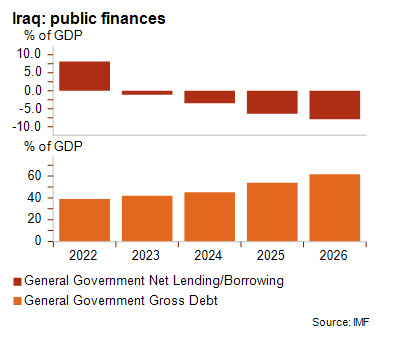
The shock is also expected to further aggravate socioeconomic conditions. Amid growing fiscal strains, the government could face difficulties in meeting payroll obligations, which represents a significant risk factor, as the public sector accounts for a large share of total employment. In parallel, the depreciation of the Iraqi dinar, combined with the disruption of supply chains, is likely to fuel inflationary pressures and intensify social tensions. By contrast, the confirmation of the new prime minister, Ali al-Zaidi, is a positive development, that could enable the government to take measures to address the country’s challenges.
Moreover, Iraq’s very large foreign exchange reserves, covering several months of imports, act as an important buffer against liquidity pressures. That being said, a potential source of risk is that part of Iraq’s foreign exchange reserves is held at the Federal Reserve Bank of New York, which leaves the country highly vulnerable in the event of US sanctions. In this context, it is important to note that the US has recently tightened its sanctions on Iraq under a campaign to exert pressure on Iran and its regional network, and has decided to restrict physical US dollar transfers to the country in order to pressure the Iraqi authorities to rein in Iran-backed militias. This decision could increase liquidity pressures. Moreover, the risk of additional US measures cannot be ruled out.
Therefore, the outlook for the country remains highly challenging, and adverse effects would only intensify in the event of a prolonged stalemate and/or renewed escalation. A key downside risk relates to the potential for lasting damage to critical oil fields in the event of prolonged shutdowns of oil facilities, which could durably impact Iraq’s oil production capacity. Even if the US and Iran reach a short-term agreement to halt the conflict, oil production will take time to resume. In addition, the risk of renewed tensions would remain elevated in the absence of a comprehensive agreement on Iran’s nuclear programme, which could delay both the recovery in oil output and the normalisation of maritime traffic through the Strait of Hormuz. Moreover, the presence of Iran-backed groups and their involvement in Iraqi politics would continue to expose the country to US economic pressure.
Given the significant security and economic challenges facing Iraq amid the ongoing Middle East conflict, including risk of additional US sanctions, Credendo decided to downgrade the classification of Iraq’s short-term political risk from category 6/7 to 7/7.
Analyst: Andres Hernandez Cardona – a.hernandezcardona@credendo.com