
Lithuania: Defence spending surge reshapes the country's fiscal outlook for the coming years

Event
In December 2025, Lithuania adopted a landmark state budget that significantly reshapes the country's fiscal outlook for the coming years. The budget features an unprecedented increase in defence spending, which rises to 5.4% of GDP (from an estimated 4% in 2025), alongside enhanced allocations for public sector wages, pensions and social support programmes. This ambitious fiscal package is permitted under the EU’s ‘national defence clause’, which allows countries to temporarily exceed standard EU budgetary requirements between 2025 and 2028 to increase defence spendings without facing penalties. As a result, Lithuania’s expenditures for 2026 are planned to surpass revenues by more than 30%, placing public debt on a rising trajectory and marking a pivotal shift in the nation’s medium-term financial landscape.
Impact
Just like the two previous years, Lithuania has entered 2026 with a favourable growth outlook that continues to outpace the euro area average. Real GDP growth was indeed estimated at 2.7% in both 2024 and 2025, and forecast to reach 2.9% this year, according to the latest IMF WEO (October 2025). Most indicators have normalised after the pandemic and the inflationary shock caused by Russia's war in Ukraine, and US tariffs and the adverse geopolitical context are having a limited economic effect. Rising real wages and sustained consumer purchasing power providing a solid foundation for private consumption, as well as investment support the short term economic expansion.
Public finances in Lithuania have remained sound up to 2025, with an estimated public-debt-to-GDP ratio at 42% in 2025, which is well below the EU Maastricht criteria of 60%, and a general government deficit of 2.7% of GDP (an increase from the 1.3% in 2024). Meanwhile, the state budget adopted in December 2025 – particularly the unprecedented increase in defence spending to 5.4% of GDP – combined with increased funding for public sector wages, pensions, and social support programmes, and the shift to a voluntary second pillar pension system, will transform the country’s medium term fiscal landscape. In 2026, expenditures are planned to exceed revenues by more than 30%. As a result, the approved 2026–2028 budget places public debt on a rising path.
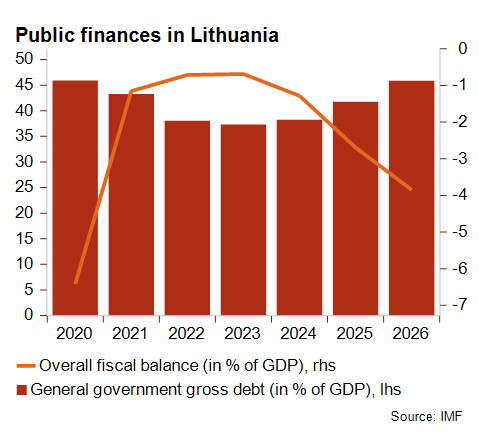
Looking ahead, Lithuania will continue to face other fiscal pressures, including unfavourable demographic trends. It will have to deal with a major demographic shock since its total population is expected to decline by 20% and its working-age population by 30% over the next 25 years, according to the OECD, which will weigh on the financing of costs related to the ageing population. The private pension savings reform, moving from mandatory auto-enrolment to a fully voluntary model as from January 2026, risks further undermining the adequacy of the pension system. In addition to those factors weighing on public finances, green transition and climate change adaptation and reparation spendings will become more and more necessary as well.
While no estimate of the trajectory of public debt in terms of GDP is yet available following the adoption of the 2026–2028 budget, the ratio is going to rise rapidly. Last September, the IMF estimated that higher defence spending at around 5% of GDP would further increase the deficit to 4.1% of GDP in 2026, with deficits remaining elevated at around 4% in the medium-term and despite additional tax revenues from the new tax measures. Public debt would rise to 55% of GDP by 2030, reaching 60% of GDP by 2033, i.e. exceeding the 60% of GDP threshold of the Maastricht criteria. As a result, a serious tax reform would have to be carried out if the trajectory is to be kept under control. Fiscal vulnerabilities are therefore undoubtedly growing.
In spite of this, Lithuania is considered at a low overall risk of sovereign stress with sustainable public debt and no financing difficulties, according to the IMF. Financial risks are also mitigated by Lithuania’s euro membership, allowing the ECB to act as a lender of last resort in case of a loss of confidence in the country’s liquidity.
Analyst: Florence Thiéry – f.thiery@credendo.com