
Bulgaria’s political reset: Radev’s victory signals a new era of stability and reform

Event
Just a few months after Bulgaria joined the eurozone on 1 January 2026, pro-Russian former President Rumen Radev won Bulgaria’s parliamentary election on 19 April 2026 with almost 45% of the votes and an absolute majority of seats, securing an outright parliamentary majority. His ‘Progressive Bulgaria’ party, founded only months before the election, won the country’s eighth parliamentary election in five years on an anti-graft programme after massive anti-corruption protests toppled the previous government in December. The new government is expected to be formed before the end of the week.
Impact
The outright majority secured by Rumen Radev’s party represents a significant turning point for Bulgaria, ending a prolonged period of political instability. After years of frequent elections and fragile coalition governments, this renewed stability is expected to facilitate the implementation of reforms and reduce uncertainty for businesses, thereby encouraging economic activity.
According to Radev’s electoral pledges, the new government is set to pursue a domestic programme focused on two priorities: dismantling what it describes as ‘the oligarchic model’ and accelerating economic development. Judicial reform is a top priority in pursuit of the former and is also supported by the country’s main opposition coalition, which strengthens confidence in the political backing for its implementation. An overhaul of the Supreme Judicial Council is expected to be one of the first justice reforms.
Bulgaria’s macroeconomic indicators have remained favourable in recent years. Since joining the EU in 2007, the country has recorded robust economic growth, while its recent accession to the eurozone is expected to provide an additional short-term boost, with growth projected at around 2.8% in 2026. Moreover, President Radev’s economic programme aims to foster a predictable business environment, which could support private investment and strengthen growth prospects over the longer term. That said, growth in recent years has been largely driven by domestic demand, while external demand has remained subdued. This reflects slower growth in key EU markets and persistent global uncertainty linked to developments in the MENA region, and these factors could also weigh on economic growth in the future. The current account balance is expected to remain negative but moderate, at around -4% of GDP in 2026. The current account deficit is projected to gradually narrow in the near term, depending on the path of oil prices, given Bulgaria’s status as a net oil importer.
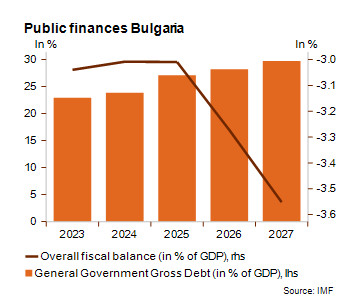
The new government faces several economic challenges, including renewed concerns over inflation and energy prices. In response to rising fuel prices linked to the conflict in the MENA region, the authorities have introduced support measures for transport and energy-intensive industries amounting to 0.2% of GDP, one of the highest percentages in the EU, second only to Spain. The low debt-to-GDP ratio (27% in 2025) does allow for some room for manoeuvre, although the fiscal deficit stands above the Maastricht threshold of 3% of GDP and is expected to remain there in the coming years owing to expenditure in areas such as defence, internal security and demographic change. As a result, public debt is expected to follow an upward trajectory while remaining sustainable. In the financial sector, systemic risks in the real estate market have increased owing to the rapid rise in mortgage loans in recent years and should be monitored closely. Finally, Bulgaria’s income inequality is among the highest in the EU and has been an important driver of protests in recent years. Although this is partly attributable to the flat tax system, under which individuals and businesses are taxed at 10% and which clearly benefits wealthier groups, the authorities are not currently considering any adjustments to the tax regime.
Radev’s pro-Russian stance has raised concerns about Bulgaria’s position in European policy-making, as he consistently opposed military aid to Ukraine and criticised EU policies during his nine-year presidency, which ended in January. However, his approach is expected to remain moderate, unlike that of Hungarian Prime Minister Orbán, not least because Bulgaria remains deeply reliant on European funds. He will more likely seek to dilute Sofia’s support for Kyiv, for which Bulgaria is a key supplier of ammunition, and push for the resumption of Russian oil and gas imports, prioritising lower-cost energy supplies. Despite these positions, Bulgaria’s full accession to the Schengen Area and its recent adoption of the euro are expected to support continuity in foreign policy, making a reversal of its Euro-Atlantic stance unlikely.
Credendo assigns Bulgaria a business environment risk rating of C/G. The reform agenda and the pro-business approach of the incoming Radev government point to a potentially improved outlook. However, continued inflationary pressures linked to the conflict in the Middle East may bring some headwinds.
Analyst: Florence Thiéry – f.thiery@credendo.com