
Tanzania: Irregularities and unrest after October election detract from good economic performance

Event
On 29 October, Tanzania held presidential elections, in which incumbent President Samia Suluhu Hassan claimed victory with over 97% of the votes. The election process was marred by reports of widespread electoral irregularities, while several key opposition figures were jailed, or barred from participating, in the run-up to the vote.
The election triggered violent nationwide protests, with demonstrators clashing with security forces in major cities. The government responded with a nationwide internet shutdown, curfews and a heavy security crackdown. Human rights groups and opposition parties claimed that hundreds of civilians were killed during the unrest.
Impact
The political repression, which increased notably in recent years, sharply contrasts with the relative openness that characterised the start of President Samia Suluhu Hassan’s administration following the death of President John Magufuli in 2021. Developments involving opposition leader Tundu Lissu illustrate the shrinking of political space in recent years. In January 2023, the leader of the Chadema party was permitted to return to Tanzania following five years of exile in Belgium. However, he was arrested multiple times in 2024 and 2025, and in April 2025 he was disqualified from participating in the October election.
Another aspect of President Samia Suluhu Hassan's policy reforms involved a significant shift in foreign policy, reversing many of the isolationist positions held by the previous administration. Under her leadership, Tanzania’s relationship with the IMF improved drastically. The country also became a member of the African Continental Free Trade Area (AfCFTA) and addressed trade barriers with neighbouring countries. Additionally, the East African nation secured international agreements to enhance its infrastructure, including Chinese financing for the modernisation of the TAZARA railway and an agreement with Dubai-based DP World to upgrade the port of Dar es Salaam. It remains thus to be seen how the international community will react to the recent election and its consequences, and whether Tanzania will remain on its path to more economic openness.
The political upheaval that followed the October election contrasts with the positive developments in the economic sphere. Tanzania’s economy has been on a robust growth trajectory over the last couple of years (see graph below). The tourism sector, which was hit hard by the pandemic in 2020, made a remarkable recovery, and registered record-high numbers of international tourists in 2024. The country ranks among Africa’s top gold exporters, and as gold prices hover near record levels, miners enjoy strong revenues. Climbing export revenues also helped the current account deficit to narrow sharply, from 7.4% of GDP in 2022 to only 2.6% in 2025.

Tanzania’s public debt is among the lowest in the region at slightly below 50% of GDP in 2025. However, when measured against government revenues, the debt burden becomes a reason for concern, given low revenue mobilisation: public revenues have hovered around 15% of GDP over the last couple of years. The IMF assesses the country’s risk of overall public debt distress as moderate. However, a positive element is that a significant portion of Tanzania’s external debt is held on concessional terms, and the government limited non-concessional borrowing in recent years.
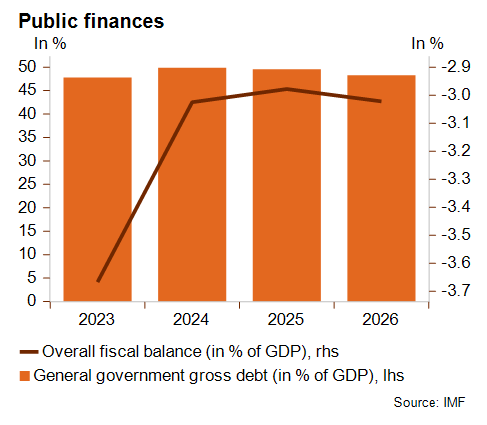
Other macroeconomic indicators also reflect stability: inflation increased slightly, from 3% in late 2024 to 3.5% in 2025, a relatively low level, and the Tanzanian shilling generally held steady against the USD throughout 2025.
Despite Tanzania’s progress in economic recovery and international relations under President Samia Suluhu Hassan, setbacks in political freedoms and unrest following the disputed presidential election have tempered these gains. Consequently, the MLT political risk (6/7) and ST political risk (4/7) classifications are maintained in their current categories for the time being.
Analyst: Jonathan Schotte – j.schotte@credendo.com