
Kazakhstan: A nation set to capitalise from its vast natural resources and investor appeal

Highlights
- Kazakhstan’s strong macroeconomic fundamentals promote economic resilience, despite successive external shocks.
- The MLT outlook is supported by the expected acceleration of the Middle Corridor amid global supply chain diversification, stronger FDI (notably in critical minerals) and deepening regional trade integration.
- Kazakhstan’s main risks come from reliance on its key domestic oil industry, which is vulnerable to the war in Ukraine and subject to Russia’s leverage.
- However, Kazakhstan’s oil industry mitigates the fallout of the Middle East conflict and the current Russian fuel crisis.
- The MLT political risk outlook is stable after its recent upgrade to 4/7.
Pros
Cons
Head of State
Head of Government
Population
GNP per capita
Income group
Main export products
Economic resilience and good MLT prospects
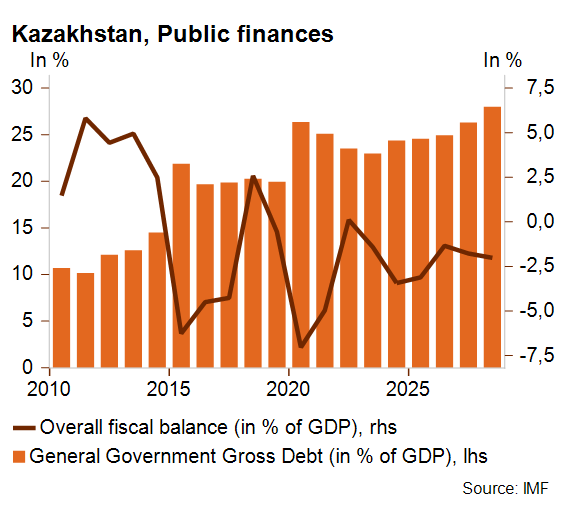
Despite several external shocks in recent years (Covid-19, the war in Ukraine, conflict in the Middle East), Kazakhstan has continued to show economic resilience. Macroeconomic fundamentals are sound with solid public finances (public debt stood at 25% of GDP, fiscal deficit was contained at 3% of GDP last year), a manageable current account deficit, and a subdued external debt and debt service.
The country’s economy also benefits from investments related to China’s Belt and Road Initiative and from political stability under President Tokayev’s consolidating rule – though protests do occur sporadically, which peaked in January 2022 when Russian troops arrived to quell the unrest. The boost to regional trade and connectivity – notably with Uzbekistan – is also likely to support economic prospects, while in the context of shifting global supply chains and the quest for more diversification and economic resilience, large powers (including the EU) have shown a high interest in Kazakhstan’s strong economic and trade potential, and vast natural resources. Indeed, Kazakhstan is endowed with substantial commodity wealth, including oil, gas, uranium and critical minerals, leading to strong trade and investment commitments in transport and digital infrastructure, logistics, energy and critical minerals. Moreover, Astana is trading its resources against access to technologies. The Kazakh authorities aim to turn the country into a digital and AI hub in Central Asia, benefiting from crucial support from China to modernise technology, such as for the development of the Data Centre Valley project in the northeast of the country. This will contribute to Kazakhstan’s positive economic prospects, and helped to generate the country’s MLT political risk rating upgrade from 5/7 to 4/7 last June.
Kazakhstan’s fuel industry: a collateral victim of the war in Ukraine
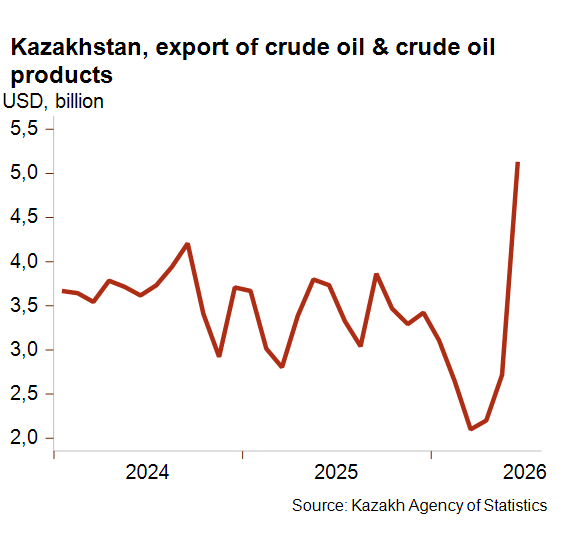
Meanwhile, the Kazakh economy remains largely driven by the oil and gas sector. That’s why, with oil exports accounting for about half of total current account receipts, Astana wants to diversify its economy to reduce oil vulnerabilities and trade dependence on Russia. While the former makes the country dependent on volatile international prices, the latter exposure is a weakness amid the war in Ukraine, as the key Caspian Pipeline Consortium (CPC, accounting for 80% of Kazakh oil exports) goes through Russia. In addition to offering Russia political and economic leverage, as testified by several temporary closures and disruptions in the past, this key risk became increasingly visible when Ukrainian drones struck the Russian section of the CPC and tankers in the Black Sea in 2025 and earlier this year. The resulting damage led to disrupted oil output, reduced exports and GDP growth. As long as the conflict in Ukraine endures – and any ceasefire still looks remote –, the risk of further attacks that generate economic and security risks will persist, threatening Kazakhstan’s neutral stance in the conflict. This situation could improve in the coming months, after Kyiv agreed to stop attacking CPC infrastructure and tankers serving Kazak oil exports as per the US request in August.
The Middle Corridor will see an accelerated expansion
Another risk related to the conflict comes from secondary EU sanctions against Kazakhstan’s re-exports to Russia, in the case that these circumvent existing sanctions. Although some entities and banks have been targeted by EU sanctions, this risk is nevertheless mitigated by the good bilateral relation and geoeconomic importance of the largest Central Asian country for the EU. More importantly, in the medium-to-long term Astana is determined to accelerate the expansion of trade via the “Middle Corridor” (also known as the Trans-Caspian International Transport Route, linking China to the EU) that bypasses Russia. However, this will require many years of infrastructure modernisation and an improvement in logistics, regulations and customs to make it more attractive and efficient.
Oil production mitigates the impact from the Middle Eastern conflict
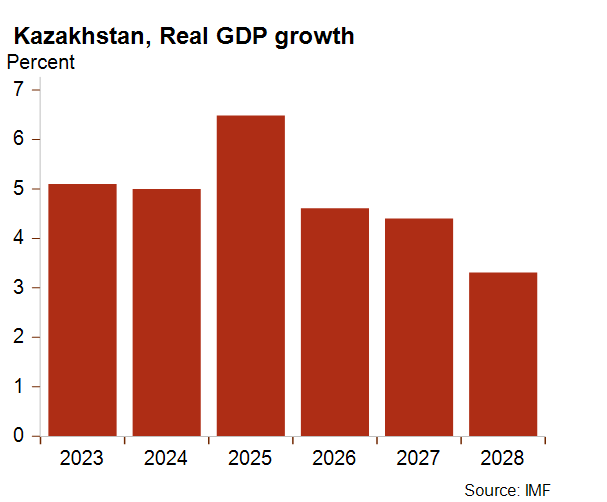
In the current conflict in the Middle East, Kazakhstan looks set to be a relative winner, with its oil sector and high international prices more than offsetting reduced oil production and boosting exports in value. The country has also been spared from fuel shortages related to Russia’s refined fuel crisis. However, this will not prevent GDP growth from decelerating to less than 4% in the MLT from a 14-year high in 2025 (+6.5%).
Higher input costs and fiscal expansion could maintain double-digit inflation for a protracted period, whereas the current account is widening on the back of stronger imports. On the upside, the outlook for external debt and current account appears to show as quite stable in the coming years. Looking ahead, eyes will be on foreign exchange reserves (excluding gold) that have been on a downward path since April 2025, dropping by more than 30% in June 2026 (six weeks of imports).
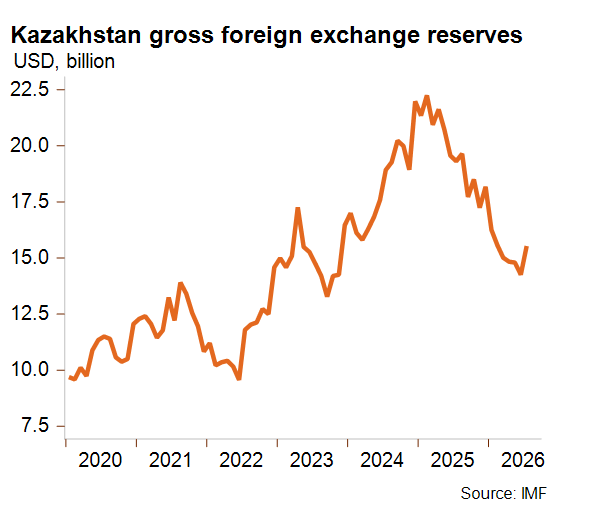
On the other hand, liquidity risks are greatly mitigated by large gold reserves and potential transfers from Kazakhstan’s sovereign wealth fund fuelled by oil revenues. The latter is equivalent to three times the volume of foreign exchange reserves, contributing to Kazakhstan’s good ST political risk rating (2/7).
Analyst: Raphaël Cecchi – r.cecchi@credendo.com