
South Africa: Government of national unity faces great challenges

Event
During the general election of 29 May, the ANC (African National Congress) lost its parliamentary majority for the first time since the end of apartheid as voters vented their anger over power cuts, corruption and the collapse of (social) services. Despite daunting scenarios of a long-lasting political deadlock and destabilisation, a coalition deal was brokered rather swiftly. The main opposition and pro-market party, the Democratic Alliance (DA), agreed to form a government of national unity with its historic rival, the ANC, and eight other small parties (including a Zulu nationalist party, the Inkatha Freedom Party and some micro parties). The alliance managed to exclude the main populist opposition parties and paved the way for Cyril Ramaphosa to retain the presidency and continue with economic centrist policies.
Impact
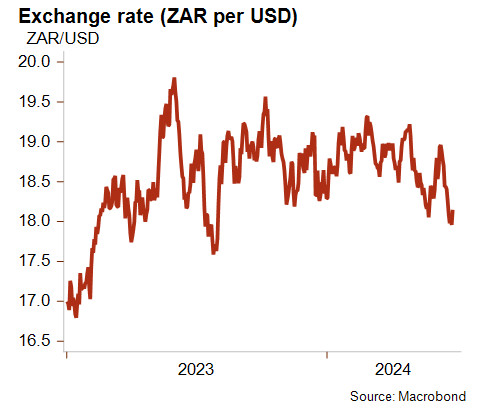
Following a campaign focussed on nationalising banks and critical industries, and on scrapping the constitution, the exclusion from government of the radical Economic Freedom Fighters (EFF) and former President Zuma’s uMkhonto weSizwe Party (MKP), reassured markets and international investors. Instead, the coalition agreement emphasised stability, after which the South African rand immediately strengthened against the US dollar (see graph, a decline in the graph represents an appreciation of the exchange rate). Nevertheless, the coalition could be fragile due to internal tensions over ideological disagreements (for example on land reforms and social welfare), with left-wing factions that might defect to the MKP or EFF. Even during the currently ongoing cabinet formation phase, disagreements have arisen on how to share power between the DA and ANC. Moreover, fiscal tightening could incite opposition mobilisation, possibly provoking large demonstrations and (violent) protests. Following years of economic stagnation under former ANC leadership, the new government needs to find the courage to implement essential structural reforms to tackle the untenable unemployment levels, enormous infrastructure gaps and energy deficit leading to detrimental power outages, and to rehabilitate distressed state-owned entities while keeping public finances healthy. The economic outlook for 2024 and 2025 is set to improve following the government formation and the anticipated gradual stabilisation of the country’s power supply.
Analyst: Louise Van Cauwenbergh – l.vancauwenbergh@credendo.com