
Agriculture sector: El Niño returns at a challenging time for global agriculture

A strengthening El Niño in a fragile global context
A new El Niño event is now firmly established and is expected to strengthen further in the coming months. According to the World Meteorological Organisation (WMO), there is a near 100% probability that El Niño will persist until at least February 2027, with its impacts likely to continue beyond that date. Forecasts also suggest that the event could reach very strong intensity (“super El Niño”) before peaking at the end of 2026.
El Niño is a natural climate phenomenon that occurs when surface waters in the central and eastern Pacific Ocean become unusually warm, disrupting weather patterns worldwide. It typically occurs every two to seven years and lasts around nine to twelve months. The current El Niño is drawing attention because it is expected to be unusually strong, supported by exceptionally warm ocean conditions. The 2026-2027 event could rank among the strongest on record, increasing the risk of severe droughts, floods, heatwaves and storms.
This El Niño comes at a particularly challenging time for the global economy. Its impacts are unfolding against a backdrop of climate change, with global temperatures already around 1.4 °C higher than pre-industrial levels. Agricultural markets are also under pressure from geopolitical tensions linked to the conflicts in the Middle East and Ukraine, which have disrupted energy, fertiliser and grain supplies and raised production costs across the agriculture and agrifood supply chain. In this context, El Niño could further disrupt food production, worsen food insecurity and push inflation higher.
Uneven regional impacts
El Niño typically brings drier conditions to South and Southeast Asia and some Pacific Islands, increasing the risk of drought, water shortages and lower agricultural yields. In contrast, Central Asia often experiences heavier rainfall, which raises the risk of floods, landslides and crop damage. Across Africa, the phenomenon creates contrasting weather patterns: the Horn of Africa often faces flooding, while southern Africa, West Africa and the Sahel tend to see below-average rainfall, reducing crop yields, weakening livestock productivity and worsening food insecurity. In Latin America, northern South America and Central America are generally exposed to drier conditions, especially in the Dry Corridor.
For more information on El Niño and its impacts, you can read this article of the National Oceanic and Atmospheric Administration.
Impact on key agricultural commodities
El Niño has uneven effects across agricultural markets, depending on crop location and sensitivity to changes in rainfall and temperature.
- Rice
Rice is among the commodities most exposed to El Niño because production is heavily concentrated in monsoon-dependent Asian countries. Reduced rainfall in India and Southeast Asia can lower yields, deplete irrigation reservoirs and increase the risk of export restrictions. Given Asia’s central role in global rice production, even moderate weather disruptions can quickly tighten global supplies and drive prices higher, as seen during previous El Niño episodes.
- Corn and soybeans
Unlike most tropical crops, corn and soybeans can benefit from El Niño in parts of South America. Increased rainfall in southern Brazil and Argentina often improves soil moisture and supports crop development, particularly for soybeans. However, drier conditions in Brazil’s central and northern producing regions may delay planting and reduce second-crop corn yields.
- Coffee
Coffee is highly vulnerable to El Niño because key producing countries, including Brazil, Vietnam and Indonesia, often experience heat stress and rainfall shortages. In Brazil, excessive heat and uneven rainfall can disrupt flowering and reduce arabica yields, while prolonged dryness in Vietnam and Indonesia may affect robusta production. These supply risks frequently trigger strong market reactions, making coffee one of the agricultural commodities most prone to price spikes during El Niño events.
- Cocoa
Cocoa is particularly exposed to El Niño because production is concentrated in West Africa, which supplies the majority of global cocoa beans. Higher temperatures, drought and irregular rainfall can weaken pod development, reduce harvests and increase vulnerability to pests and diseases. Because global cocoa inventories remain relatively tight, even small production losses can lead to disproportionate price increases.
- Sugar
Sugar markets are vulnerable to El Niño through its effects on sugarcane production in Asia. Reduced rainfall in major producers such as India and Thailand can lower yields and limit export availability, tightening global supplies. While Brazil may partially compensate with strong harvests, excessive rainfall can also disrupt harvesting and milling operations. Consequently, El Niño is generally associated with upward pressure on global sugar prices.
- Palm oil
Palm oil production is heavily concentrated in Indonesia and Malaysia, where El Niño typically brings drier and hotter conditions. Water stress can reduce palm fruit development, with yield losses often appearing several months after the initial weather shock. Given that these two countries account for more than 80% of global palm oil supplies, prolonged El Niño conditions can significantly tighten the market and support higher vegetable oil prices worldwide.
El Niño could also push prices higher for other commodities, including fruits and cotton. Beyond its impact on crop yields, it can disrupt food supply chains and exacerbate inflationary pressures. Lower rainfall in key transit regions can reduce water levels in strategic waterways, disrupting trade flows for agricultural commodities and inputs. For example, the Panama Canal has previously had to restrict vessel traffic because of drought conditions linked to El Niño, increasing shipping costs and delays. El Niño can also reduce hydroelectric power generation in several countries, while drought-related disruptions to energy infrastructure may further increase energy prices.
Compounding risks for agricultural markets
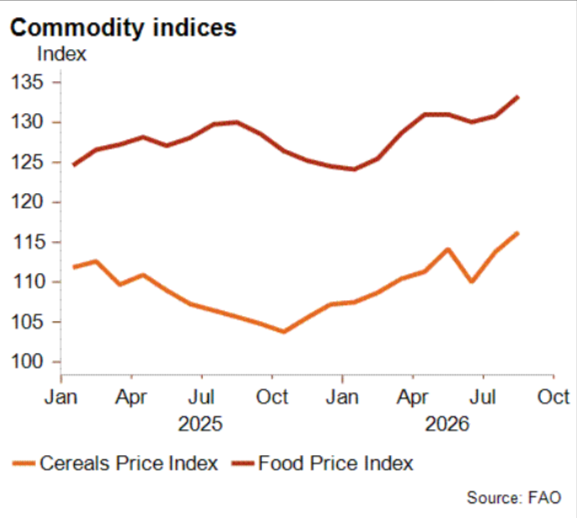
These effects are particularly concerning because the risks posed by El Niño come on top of an already fragile global food market. Agricultural supply chains have been disrupted by the conflict in the Middle East, which has pushed up energy prices and increased fertiliser costs while also threatening the availability of key inputs such as ammonia, urea and sulphur. At the same time, renewed attacks on ports and export infrastructure in the Black Sea region have disrupted grain shipments from Russia and Ukraine, two of the world’s most important cereal exporters. Europe also experienced severe drought conditions in the summer of 2026, reducing yields for several crops, particularly maize and oilseeds, while low water levels on major rivers such as the Rhine and Danube increased freight costs and disrupted inland transport. These disruptions have already contributed to food and cereal price inflation this year, as shown in the graph below. Against this backdrop of geopolitical tensions, supply chain disruptions and weather-related crop losses, a strengthening El Niño could further tighten agricultural markets, increase food price volatility and amplify inflationary pressures worldwide.
Conclusion: El Niño’s impact on global food markets and country risk
El Niño’s impact extends far beyond individual crops. Coming on top of existing geopolitical tensions, supply chain disruptions and rising energy and fertiliser costs, it could amplify pressure across global food markets. The result could be greater agricultural volatility, higher food prices, disrupted trade flows and growing food insecurity, particularly in vulnerable developing economies.
More broadly, El Niño can also affect country risk. In highly exposed economies, weaker agricultural output can weigh on economic growth and drive up food and energy inflation. Combined with possible food shortages, this can worsen poverty and inequality and increase the risk of social unrest or political violence. Persistently higher inflation may also keep monetary policy tighter for longer, raising borrowing costs for companies and governments. At the same time, support measures such as subsidies, price caps or trade restrictions could add pressure on public finances and increase protectionist risks.
Analyst: Laura Pierssens – l.pierssens@credendo.com