
Thailand: Turbulent times on the political, security and economic fronts

Event
After it suspended PM Paetongtarn Shinawatra from office on 1 July – after a controversial phone call judged critical of the Thai military leaked from a conversation she had with former Cambodian PM Hun Sen –, Thailand’s Constitutional Court dismissed her for ethics violations on 29 August. The Pheu Thai party (the dominant party of the ruling government coalition) will try to replace its leader by a party member to preserve the government and avoid snap elections. This political instability resurfaces in a context of persisting high tensions with Cambodia. The renewed border conflict culminated in a direct military confrontation between 24 and 27 July – resulting in dozens of deaths and displacing hundreds of thousands of people – until a ceasefire was agreed thanks to external mediation and pressures.
Impact
The prospect of anticipated elections highlights again the Thai society fragmentation between populists and royal conservatives, and could give a large share of the population a new opportunity to express their discontent with the political system. As a reminder, the winner party of the previous general elections of May 2023, the Move Forward party, was dissolved by the Constitutional Court in 2024 and its leaders banned from politics for ten years for alleged threat against the monarchy. Though we are not there yet, a new military coup to preserve domestic stability is therefore not to be ruled out, should the military and elite’s grip on power feel threatened. This is a scenario that the Thai population knows too well (when looking at the last two decades) and that could repeat itself endlessly as long as the military-shaped constitution is not reformed.
In addition, tensions with Cambodia remain very high. Although both sides do not seem to want to be involved in a prolonged military conflict, whose economic losses would add to an already difficult economic context, external intervention (first from Malaysia, AESAN’s current Chair) and both US and Chinese pressures were necessary to reach a ceasefire. However, rising nationalism and the political situation raise doubts about their ability to resolve these longstanding territorial disputes. The risk is that current talks mediated by Malaysia may deliver limited results and leave tensions open, with the threat of hostilities resuming in the future.
Besides those political and security developments, the economic situation looks quite positive. On 1 August, Thailand managed to reduce the US tariffs on exports from 36% to 19% after concluding a trade agreement with the US, its first export market (18% of exports of goods). Importantly, this tariff reduces to a tariff rate similar to that imposed on other major Southeast Asian competitors. Nevertheless, Thailand had to make wide concessions to the US, notably preferential treatment for US investments and zero tariffs on many US goods, which could threaten some domestic industries. Moreover, just as for several regional peers, the potential additional US punitive tariff on Thailand’s transhipped goods (targeting goods of Chinese origin) is another risk to consider for Thai exporters, notably as uncertainties about how controls will be implemented and their reliability remains.
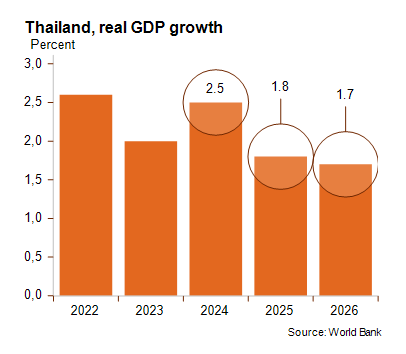
While Thailand’s economy showed resilience in the first half year, boosted by export front-loading, high US tariffs are expected to weigh on Thailand’s export-led economy and manufacturing industry. In addition, weakened consumer confidence, amid political turmoil and global economic uncertainty, could also harm the economic momentum. Therefore, the World Bank expects real GDP growth to fall to 1.8% this year (from 2.5% in 2024) and to further decelerate to 1.7% in 2026. The business environment risk rating is expected to remain stable (D/G) in the coming months, the same applies to the MLT political risk rating (3/7).
Analyst: Raphaël Cecchi – r.cecchi@credendo.com