
Global energy crisis triggered by Strait of Hormuz blockade and energy infrastructure damages

Event
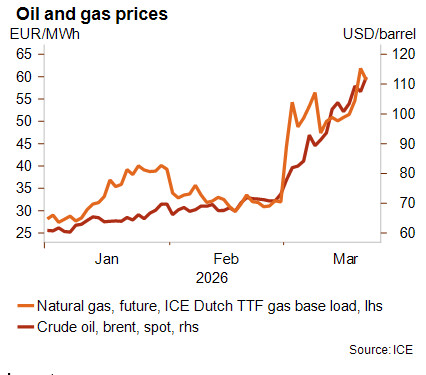
As operation Epic Fury enters its fourth week, it is now clear that, besides its large humanitarian impact, it is also having a significant negative impact on the world economy. Indeed, the Strait of Hormuz – a key bottleneck for global oil and LNG transit – remains de facto closed, which affects global supply of oil and gas, but also of aluminium, fertilisers, sulphur, naphtha as well as other materials. What is more, since last week, the conflict has been escalating with increased targeting of critical infrastructure, in particular energy infrastructure. Notable targets have been the United Arab Emirates’ Shah oil and gas field, Saudi Arabia’s Shaybah and Berri fields and Qatar’s Ras Laffan industrial site – which produces one fifth of global LNG supplies and has suffered from extensive damage. For the latter, it is already clear that it will have medium-term repercussions as it is estimated that it would take between three to five years to repair, resulting in large reductions in LNG production since it accounts for around 17% of Qatar’s LNG export capacity. In this context, IEA Executive Director Fatih Birol stated that “the war in the Middle East is creating a major energy crisis, including the largest supply disruption in the history of the global oil market. In the absence of a swift resolution, the impacts on energy markets and economies are set to become more and more severe.”
Impact
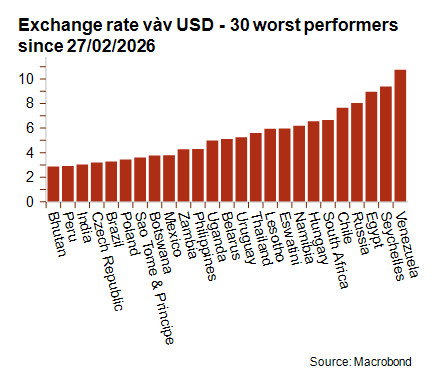
This substantial shock is leading to a marked deterioration in global economic activity and puts upward pressure on worldwide inflation, implying that financial conditions are likely to be tighter than they would have been without the conflict. Moreover, global financial conditions are deteriorating, notably amid a sharp reversal in investor confidence and a sudden stop in capital flows coming from the Gulf. The exchange rate of many currencies has depreciated (see graph below). The countries most affected are energy importers in Asia, given the region’s reliance on oil, gas and remittances from the Gulf, as well as energy-importing countries in Europe and Africa.
Apart from Japan and China, Asia has limited strategic oil and LNG reserves. As a result, the conflict is compelling many Asian governments to take extraordinary measures to address the crisis, like increasing energy subsidies (Indonesia, Malaysia, Thailand). Other measures, such as the introduction of fuel rationing and the advice to reduce working hours are weighing on manufacturing production. Moreover, there is also the risk that some governments might choose to prioritise households when allocating fuel, which would deepen the impacts for enterprises. Inflation and currency pressures are two other factors that will affect the regional economic activity. Based on their high level of energy and economic dependence on the Gulf and given their more fragile macroeconomic fundamentals, South Asian countries – especially Pakistan, Bangladesh and Sri Lanka – are most exposed to the current shock.
Looking ahead, although recent reports indicate productive negotiations between the US and Iran, significant uncertainty persists given the divergences and deep mistrust between both parties. In this context, establishing a credible path towards de-escalation could be challenging. Even in the event of a halt in hostilities by the US and Israel, Iran’s response remains unknown. Facing what it may perceive as a persistent existential threat and heightened domestic instability, it might continue counterattacks or, at a minimum, maintain threats against ships in the Strait of Hormuz. Under such a scenario, spillovers to the region would remain significant. Overall, the outcome of the conflict is highly unpredictable.
In this uncertain context, Credendo has a negative outlook for its country risk classifications, starting with the Gulf and the business environment risk of energy importers in Asia, Europe and Africa.
Analysts: Andres Hernandez Cardona (A.HernandezCardona@credendo.com), Raphaël Cecchi (R.Cecchi@credendo.com) and Pascaline della Faille (P.dellaFaille@credendo.com)