
Automotive sector: Is Europe losing its edge in the global automotive industry?

Europe’s automotive industry stands at a crossroads. As a cornerstone of the European economy, it supports 13.5 million1 direct and indirect jobs, accounts for nearly 7% of total EU employment and remains the region’s largest private investor in research and development. Automotive companies invested EUR 84.3 billion in R&D in 2024, representing roughly one third of all private R&D spending in the European Union. Yet despite its scale and technological strength, the sector is facing growing pressure on multiple fronts.
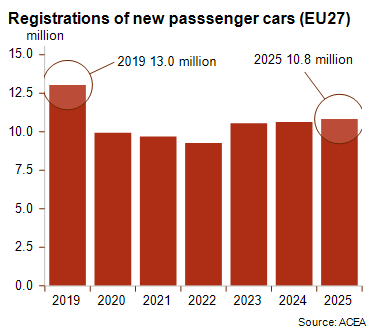
European passenger car demand remains subdued. Registrations increased by only 1.4% in 2025, while sales remain around 17% below 2019 levels, as illustrated in the graph below. Persistently high vehicle prices, elevated borrowing costs, weak consumer confidence, modest economic growth and changing mobility patterns continue to weigh on market recovery.
At the same time, EU passenger car production has struggled to regain momentum amid intensifying international competition. Production rose by a marginal 0.3% in 2025 to just under 11.5 million vehicles, remaining far below the 15.8 million vehicles produced in 2019 before the pandemic. European manufacturers are also steadily losing market share to Asian competitors, particularly Chinese producers.
Moreover, the sector is undergoing a profound structural transformation. Manufacturers are consolidating operations, rationalising excess capacity and redirecting investment towards electrification, batteries and digital technologies. Some companies are also exploring alternative uses for underutilised industrial assets, including defence-related projects. However, such initiatives are unlikely to fully compensate for the decline in conventional vehicle manufacturing, particularly in regions that remain heavily dependent on the automotive industry.
The industry’s increasingly difficult operating environment is already triggering significant restructuring. Manufacturers and suppliers across Europe are closing plants, reducing capacity and cutting jobs in response to weak demand, rising competition and the costly transition to electric vehicles (EVs). Automotive suppliers alone announced nearly 19,000 job losses in the first half of 2026, while several major carmakers launched large-scale restructuring programmes. Recent profit warnings, including from Volkswagen, BMW, Mercedes-Benz and Renault, highlight the growing strain on the sector’s financial performance. Although employment in batteries, software and electromobility is expanding, these gains remain insufficient to offset job losses in traditional automotive activities.
What is putting Europe’s automotive industry under pressure?
- Growing competition from China
The rise of Chinese manufacturers represents one of the most important structural challenges Europe’s automotive industry is facing. Supported by lower production costs, a large domestic market and a dominant position in batteries and critical minerals, Chinese carmakers have rapidly improved their technological capabilities and competitiveness.
The challenge for European manufacturers extends beyond growing competition in Europe. Sales in China, historically one of the industry’s most profitable markets, have weakened as domestic brands gain market share, particularly in EVs. The resulting decline in revenue and profit is limiting European manufacturers’ ability to fund the investments required for the transition to electric mobility. On top of this, slowing domestic demand and fierce competition are also putting pressure on Chinese producers, encouraging them to expand aggressively into overseas markets.
Although EU tariffs on Chinese EVs offer some protection, their effectiveness is likely to be limited as Chinese companies increasingly invest in European production facilities and battery plants. While these investments can support employment and industrial activity, they also raise concerns about Europe’s dependence on Chinese technologies and supply chains. This dynamic is contributing to a widening trade imbalance (see graph), with imports from China increasingly outpacing European automotive exports to the Chinese market.
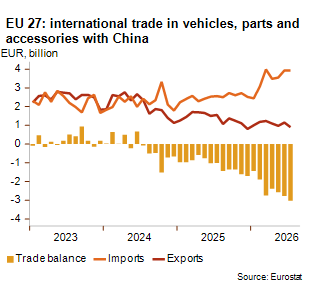
Unless European manufacturers succeed in restoring their competitiveness, the growing presence of Chinese producers and the widening trade imbalance between Europe and China are likely to remain significant headwinds for the sector. The ability to scale up EV production, reduce costs and maintain technological leadership will be critical to securing Europe’s long-term position in the global automotive market.
- High costs and declining competitiveness
European manufacturers face a significant cost disadvantage compared with many global competitors. Labour costs remain high, while energy prices continue to exceed those in several competing regions.
Although energy prices have fallen from the peaks reached during the 2022 energy crisis, electricity and natural gas costs in Europe remain structurally higher than in many competing markets. This weighs on profitability across the automotive industry and particularly affects energy-intensive sectors such as steel, aluminium and chemicals, which supply many of the key inputs used in vehicle production. While investments in renewable energy are expanding and could improve Europe’s long-term energy security and competitiveness, the transition will take time and energy costs are likely to remain elevated in the near term.
Geopolitical developments are adding further cost pressures. Ongoing tensions in the Middle East, including risks to shipping routes through the Strait of Hormuz, continue to support higher energy prices and increase uncertainty in petrochemical markets. As a result, the costs of essential automotive inputs such as plastics, synthetic rubber and chemicals remain under pressure, while higher freight rates and insurance costs further weigh on manufacturers’ margins.
- Supply-chain vulnerabilities and strategic dependencies
The resilience of Europe’s automotive industry is increasingly challenged by its dependence on external suppliers for critical materials and technologies. Batteries, semiconductors, rare earth elements and battery minerals are largely sourced from outside Europe, creating vulnerabilities that have become more apparent in an increasingly fragmented geopolitical environment.
China’s dominant position across much of the EV supply chain has heightened concerns about security of supply, particularly following recent restrictions on exports of critical minerals. Meanwhile, the concentration of semiconductor production in a limited number of countries continues to expose the industry to disruption risks, as illustrated by the chip shortages experienced during and after the pandemic. Growing demand from emerging technologies, notably artificial intelligence, is further intensifying competition for manufacturing capacity.
As the industry electrifies and digitises, securing reliable access to critical inputs will become just as important as maintaining competitiveness in vehicle production itself.
- Regulatory pressures
The automotive industry is navigating a profound technological transition while operating within an increasingly demanding regulatory framework. Stricter emissions, environmental and safety standards are requiring manufacturers to invest heavily in electrification and digital technologies. At the same time, EU CO₂ targets and the planned 2035 phase-out of sales of new internal combustion engine cars are accelerating the shift towards electric mobility.
This transition is proving particularly challenging for suppliers specialised in traditional powertrain technologies. Many face high fixed costs, limited pricing power and strong dependence on a small number of customers. While EV sales have accelerated recently, uncertainty remains over the pace of adoption across different markets and segments, making long-term investment and production decisions more difficult across the automotive value chain. Frequent policy adjustments and ongoing debates over emissions rules, industrial support measures, trade policy and local-content requirements further add to this uncertainty.
According to Bruegel, the European automotive sector requires more than trade protection to remain competitive. A comprehensive industrial strategy focused on innovation, investment, energy competitiveness and supply-chain resilience will be needed to support the sector’s long-term transformation. Current policy discussions centre on expanding domestic battery production, securing access to critical raw materials, strengthening supply-chain resilience and accelerating the deployment of charging infrastructure. At the same time, policymakers are seeking ways to support the transition to electric mobility while limiting the burden on manufacturers and suppliers.
Overall, the competitiveness of Europe’s automotive industry will depend largely on its ability to successfully navigate the green and digital transition while closing the gap with global competitors. Sustained investment in innovation, affordable energy, critical technologies and workforce skills will be essential. Europe must not only adapt to a rapidly evolving global market but also ensure that the next generation of automotive value creation remains firmly anchored in the region.
- Trade and geopolitical risks
The automotive industry remains highly exposed to shifts in trade policy and geopolitical tensions. Although recent agreements have reduced some of the tariff measures initially proposed by the USA, uncertainty surrounding future trade relations continues to weigh on the sector. Tariffs, export restrictions and regulatory barriers increase costs, disrupt supply chains and reduce visibility for long-term investment decisions.
At the same time, Europe’s automotive industry is increasingly caught in the broader strategic rivalry between the USA and China. The increasing use of tariffs, export controls, subsidies and industrial policy measures is contributing to a more fragmented global trading environment. This not only risks triggering retaliatory action but also creates new challenges for manufacturers operating across international supply chains and multiple markets.
Looking ahead, geopolitical tensions and growing economic fragmentation are likely to remain important sources of uncertainty for the automotive sector. Manufacturers will need to adapt to a less predictable trading environment in which resilience, supply-chain diversification and strategic flexibility may become as important as cost competitiveness.
Why are the stakes so high for Europe’s industrial economy?
The challenges Europe’s automotive industry is facing extend far beyond the sector itself. As a key customer for industries ranging from steel, aluminium and chemicals to machinery, plastics and logistics, the automotive sector sits at the heart of Europe’s industrial ecosystem. A prolonged decline in vehicle production would therefore have ripple effects across the wider economy, weighing on investment, employment and growth. The stakes are high: Europe’s ability to preserve a competitive and resilient automotive industry will play an important role in shaping the future of its broader manufacturing base. Whether Europe can retain its competitive edge will depend on its success in adapting to a rapidly changing industry while strengthening innovation, resilience and industrial competitiveness.
Analyst: Laura Pierssens – l.pierssens@credendo.com