
Aviation sector: Higher jet fuel prices cloud airlines’ recovery in 2026

Airlines started 2026 with stronger demand and rebuilt financial buffers
The airline industry entered 2026 in its strongest position since the Covid pandemic, following a year of record passenger volumes, stronger profitability and rebuilt financial buffers. According to IATA, net profit rose by almost 40% in 2025, while the industry’s net margin improved from 3.4% to 4.2%.
Passenger traffic benefited from strong demand growth in 2025. International travel led the recovery, with Asia-Pacific carriers posting the strongest regional growth. Cargo also reached a record high in 2025, supported by e-commerce and shipments brought forward ahead of new trade tariff increases. However, those US import tariff hikes, the removal of de minimis exemptions and continued policy uncertainty later in the year weighed on trade flows, as reflected in stagnating US-Asia trade. Air cargo remains more cyclical than passenger aviation because of its exposure to global trade, e-commerce, high-value manufacturing, perishables and time-sensitive logistics.
Before the Middle East crisis began in March, the sector was already facing two structural challenges: decarbonisation and supply-chain constraints. Delivery delays for new aircraft and engines, limited maintenance capacity and cost pressures restricted airlines’ ability to fully meet demand. Aircraft deliveries fell to 1,254 in 2024, about 30% below pre-Covid peaks, while the backlog rose to a record 17,000 aircraft. IATA estimates that these disruptions added more than USD 11 billion in costs in 2025. Airlines responded by extending the lives of existing fleets and maximising load factors, but those measures remain temporary. Faster fleet renewal is still essential to expand capacity, improve operational efficiency and reduce emissions.
Hormuz disruption reshapes profitability
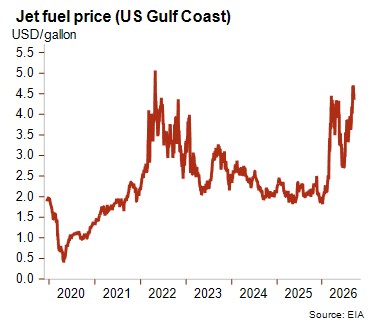
The closure of the Strait of Hormuz on 28 February 2026 abruptly changed the sector’s operating environment. The disruption removed a significant share of global jet fuel supply from the market, threatened fuel availability in Asia and Europe, pushed prices sharply higher, forced costly rerouting, disrupted Gulf airspace and tightened fleet capacity. The Middle East accounted for around 60% of Europe’s jet fuel supply in 2025.
A mid-June agreement between the USA and Iran briefly eased crude oil and petroleum product prices, including jet fuel. However, renewed attacks from July triggered a fresh price surge (see chart below). The pressure was further amplified by Russia’s ban on aviation fuel exports from 1 June to 30 November 2026, following Ukrainian strikes on Russian refineries and energy infrastructure.
For airlines, the crisis is primarily a margin compression shock. The industry operates with structurally thin margins, making weaker carriers more exposed to financial stress and a higher risk of failure. Low-cost carriers, airlines with limited hedging, Gulf-exposed operators and companies already dependent on refinancing or restructuring face the highest risk. Large diversified flag carriers and premium airlines are better placed to pass on part of the cost increase and absorb temporary disruption.
Airlines are passing part of the additional fuel cost on to consumers through higher fares. Passenger volumes remain high and continue to rise, although at a slower pace, with the Middle East as an exception. However, this will not be enough to maintain profitability at last year’s level. Regional performance is uneven. Middle Eastern airlines are expected to post a combined loss because of weaker demand and operational disruption, while all other regions should remain profitable, though below earlier forecasts.
Fuel prices dominate the short-term outlook
Ongoing disruption in the Strait of Hormuz, combined with Houthi attacks on Saudi energy infrastructure and the group's seizure of parts of Yemen’s Red Sea coast, is maintaining pressure on global oil and petroleum product supplies and pushing jet fuel prices higher in the short term.
As prospects for a diplomatic resolution of the Middle East conflict remain distant, jet fuel prices are expected to stay high in the short term, keeping pressure on airline profitability. Hedged airlines will also feel the impact over time as existing contracts expire. Although services have gradually resumed across much of the Middle East, disruption continues on several routes. Dubai remains among the most affected destinations, with several European and Asian carriers extending suspensions into October and beyond.
Longer-term demand remains intact, but supply will cap growth
Sustained medium- to long-term demand growth remains the sector’s baseline scenario, provided geopolitical disruption gradually eases. Leisure travel and visits to friends and relatives should remain key supports for demand growth over the medium to long term. Cargo demand, which has also remained resilient despite slower growth in recent months, should gradually strengthen as well.
However, the sector’s pace of growth will increasingly be determined by service supply rather than demand. Demand may be strong, but constraints and bottlenecks in aircraft and engine deliveries, maintenance, repair and overhaul capacity will limit how quickly airlines can expand. Supply-chain disruption has become a new operating norm, and the mismatch between airline demand and aircraft manufacturers’ output is not expected to rebalance until well into the next decade. Positively, this constraint on capacity expansion reduces the risk of overcapacity.
Decarbonisation will add further pressure. Several regulations are pushing the sector in this direction. In Europe, ReFuelEU Aviation requires fuel suppliers to ensure that sustainable aviation fuel accounts for 2% of fuel supplied from 2025, rising to 6% in 2030, with an additional synthetic-fuel sub-mandate from 2030. This will raise compliance costs before these products are available at sufficient scale to materially reduce prices. Despite today’s high conventional jet fuel prices, sustainable aviation fuel still costs around 1.5 to 2.5 times more.
CORSIA, the global carbon-offsetting scheme for international aviation established by the International Civil Aviation Organization of the UN, is also entering a more demanding phase. Its first phase runs from 2024 to 2026, with 130 participating countries as of 1 January 2026. The scheme aims to reduce emissions to 85% of 2019 levels through 2035, implying the purchase of more carbon offsets as international air traffic, and therefore emissions, returns towards or above pre-pandemic levels. As a result, decarbonisation is not yet a margin-supportive transition lever. It is mainly a regulatory and fuel-procurement cost burden that further limits the sector’s already weak returns.
Beyond fuel and decarbonisation, medium-term profitability will remain fragile and closely tied to the global economy, especially in cargo. Airline prospects depend heavily on global economic conditions, with high inflation and elevated interest rates likely to dampen growth. Rising cross-border trade restrictions, particularly US import tariffs, also weigh on goods trade and cargo demand. Conversely, wider disruption at maritime chokepoints could support air transport as an alternative for some time-sensitive or high-value goods.
Analyst: Florence Thiéry – f.thiery@credendo.com