
Sri Lanka: Continued reform process and good economic momentum

Event
Sri Lanka’s implementation of its four-year IMF Extended Fund Facility programme (2023-2026) is moving forward, confirmed by the IMF’s agreement on its fifth review of the programme. As a result, Sri Lanka will receive a further disbursement of about USD 350 million (out of a total loan of USD 3 billion) upon completion of the IMF Executive Board review.
Impact
Sri Lanka remains on a favourable recovery path following its external debt default and deep financial and economic crisis. More than two and half years after the IMF bailout, Sri Lanka’s economy has been on a gradually improving trajectory, growing by 5% in 2024 and 4.8% in the first half of this year according to the nation’s central bank. This solid momentum is confirmed by inflation levels, which, after a year of deflation, have been back in positive territory since August – supported by rising domestic consumption – and are expected to be at around 5% next year. The rupee has also been rather stable over the past 18 months, showing a slow return of confidence. Rising tourism receipts and workers’ remittances have also helped to support growth and keep the current account in surplus since 2023. As a result, foreign exchange reserves have surged, tripling their import cover from one month at the end of 2022 to three months in mid-2025.
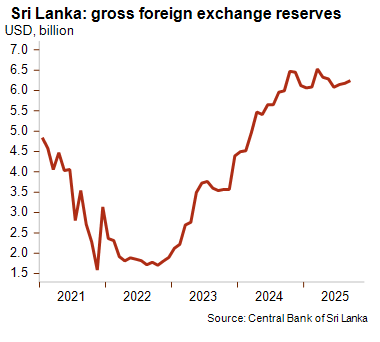
Over the past two and a half years, government policies have been focused on implementing the IMF programme to put the economy on a sustainable footing and improve the country’s economic prospects. In terms of fiscal consolidation, this is working: thanks to impressive progress in fiscal reforms, extremely low government revenues have increased from 8.4% of GDP in 2022 to an expected 15% in 2025, leading to an expected primary surplus of 2.2% of GDP in 2025. Furthermore, after domestic debt restructuring was announced in July 2023, long negotiations have been underway to find an agreement across the broad range of external creditors and the country is now in the final stages of external debt restructuring talks. Nearly all bilateral agreements have been signed with official creditors, but this will take longer for the dominant commercial creditors. To ease Sri Lanka’s debt service burden, a grace period on rescheduled loan repayments is foreseen until 2028.
While the overall picture is encouraging and macroeconomic fundamentals have been strengthened, the outlook is not without risks. Firstly, public finances remain vulnerable, with a high public debt expected at 105% of GDP this year. That said, international investor optimism has been rising with regard to Sri Lanka’s economic trend and government policies. Secondly, the country will suffer the effects of the US trade war and reduced trade with the USA, its number one export market that makes up 25% of its goods exports. However, the fact that US import tariffs have been cut to 20% as with other textile competitors such as Pakistan and Bangladesh, and that these are lower than China’s tariffs, has nevertheless brought some relief to the highly important garment sector (accounting for two thirds of Sri Lanka’s exports to the US) and the national authorities. Finally, the social climate remains tense, with higher poverty and unemployment levels, so the population is increasingly showing fatigue towards government austerity measures, leading to protests about the budget. Regardless, the economic recovery and the population’s persisting support for President Dissanayake – who won the elections just one year ago – and his NPP alliance’s parliamentary majority should allow the government to continue its reform drive.
At this stage, the outlook is positive for the ST political risk (6/7) and stable for the MLT political risk (7/7), at least until the external debt restructuring is completed.
Analyst: Raphaël Cecchi – r.cecchi@credendo.com