
Algeria: Long-standing challenges continue to shape the macroeconomic outlook

Good economic performance driven by the energy sector
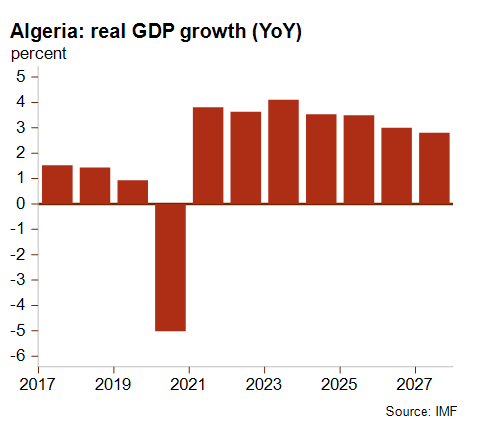
Algeria’s post-Covid-19 economic performance has been bolstered by high hydrocarbon prices resulting from the war in Ukraine alongside the EU’s efforts to diversify its energy sources. These positive conditions – for a net energy exporter – supported Algeria’s robust economic performance over the past three years, with real GDP growth averaging 3.8%. This marks a significant shift from the pre-Covid-19 period (2017-2019), which was characterised instead by tepid economic performance, with growth averaging only 1.3%. The positive economic momentum is expected to continue this year despite the important uncertainty and headwinds facing both the MENA region and the world economy. Growth should be supported by the unravelling of oil production cuts under the OPEC+ agreement, which should only partially offset the lower hydrocarbon prices. Over the medium term, real GDP growth is projected to slowdown gradually but remain relatively strong.
After temporary reprieve, macroeconomic challenges are resurfacing and are expected to persist over the medium term
Despite improved economic growth prospects, Algeria is confronted with deep structural macroeconomic challenges. A key weakness is that the economy remains very reliant on the hydrocarbon sector, which accounted for around 20% of GDP in 2021, and that export diversification is very limited, with hydrocarbons accounting for more than 75% of current account revenues in 2024. In this context, the anticipated moderation in hydrocarbon prices is putting pressure on Algeria’s current economic model once again (despite the expected increase in oil production).
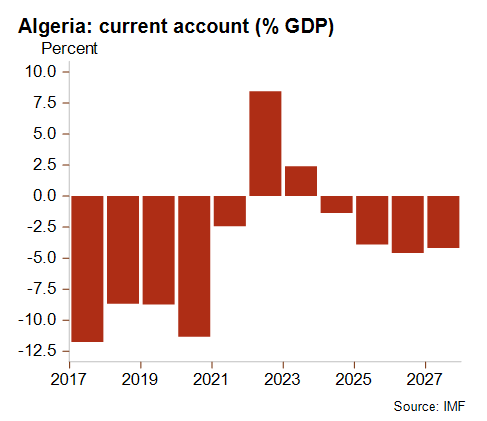
Over the years, these macroeconomic imbalances have led to large current account deficits. Indeed, in the last decade, except for 2022 and 2023 when hydrocarbon prices reached historical high levels, Algeria ran recurrent current account deficits. This trend reflects the country’s limited economic diversification, leading to a structurally large import bill, and exposing current account revenues to global hydrocarbon market fluctuations. The authorities have implemented some measures to diversify the economy and attract foreign investment (2022 investment law); however, these have yielded modest results. Measures aimed at containing the import bill have also been introduced, most recently the authorities have introduced more stringent import regulations reportedly to discourage non-essential imports and support domestic production. Still, despite these efforts, large current account deficits are expected to persist over the medium term and average 4.2% of GDP. On a slightly positive note, current account deficits are projected to narrow compared to pre-Covid-19 levels, which averaged 9.7% of GDP.
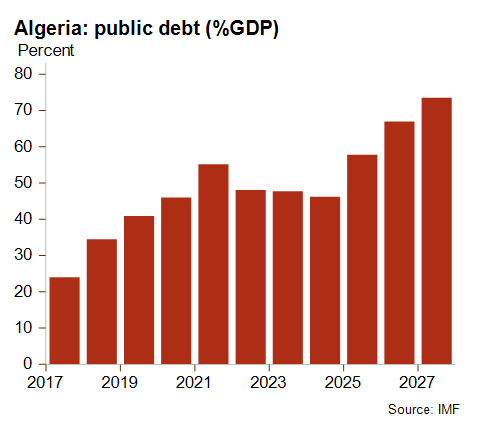
Another key challenge for Algeria is related to its fiscal position. The country is facing significant fiscal pressures, as the limited economic diversification leads fiscal revenues to be dependent on the hydrocarbon sector. In 2023, the sector accounted for more than 50% of public revenue. At the same time, fiscal flexibility remains constrained by structurally high expenditure on subsidies and public wages, among others. Over the medium term, in the absence of major fiscal reforms, the country is projected to continue to run large fiscal deficits. Therefore, public debt levels are also expected to increase significantly from this year on.
Liquidity position remains strong
On the positive side, despite the country’s twin deficits, its liquidity and overall external positions remain relatively strong. Indeed, gross external debt levels remain very low, reflecting the Algerian authorities’ aversion to external borrowing following the debt crisis in the 1990s. In 2024, external debt was estimated at less than 5% of GDP. However, despite the authorities’ reluctance, if the current external and fiscal imbalances continue, the country may be forced to resort to external borrowing.
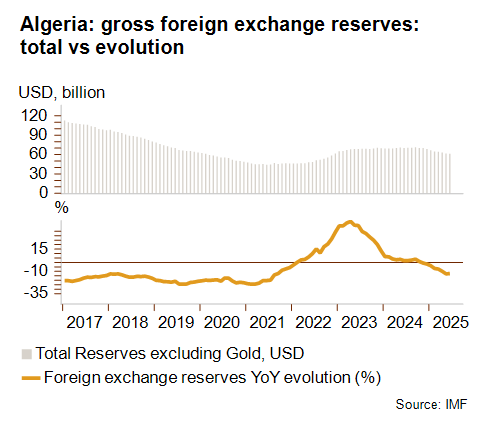
In recent years, the authorities have resorted to the vast foreign exchange reserves to finance the recurring current account deficits. However, as hydrocarbon prices are moderating, reserve erosion has re-started again after more than two years of accumulation. Despite this sharp drop, it is worth noting that reserve levels remain more than adequate for 2025, covering around one year of imports.
In this context, Algeria’s short-term political risk classification remains at 3/7. Indeed, despite the challenges facing the country, liquidity remains solid for the moment given the ample foreign exchange reserves and very low external debt levels. Notwithstanding, a more rapid-than-expected erosion of the exchange reserves could put pressure on the short-term political risk. The medium- to long-term political risk classification remains at 4/7, but the build-up of fiscal and external imbalances could put pressure on the classification.
Analyst: Andres Hernandez Cardona – a.hernandezcardona@credendo.com