Business environment risk: Six upgrades, four downgrades

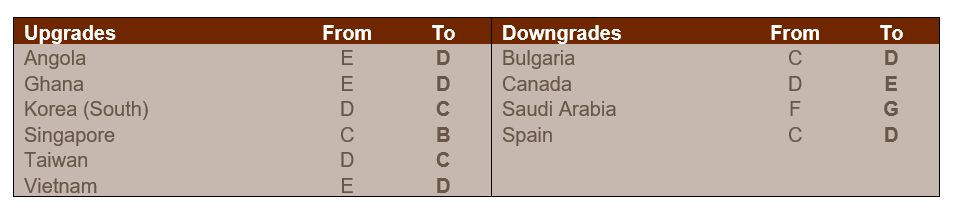
In the framework of its regular review of the business environment risk, Credendo has upgraded six countries, including several Asian economies benefiting from the AI boom, and downgraded four countries.
Business environment risk
- Asia: four upgrades
The protracted conflict in the Middle East continues to hit Asian countries through high fuel prices and their relatively heavy reliance on the Strait of Hormuz for fuel supplies. As a result, increased energy prices and constrained supply chains have affected economic activity and consumption. Nevertheless, several countries have so far shown high resilience to the energy shock, supported by strong global demand for high-tech and AI-related products. Vietnam (+8.2%), South Korea (+3.8%), Taiwan (+14.1%) and Singapore (+6.1%) therefore reported strong GDP growth in the first half of 2026. Though market corrections pose a risk to the sector’s short-term prospects, optimism about global demand for AI-related products continues to dominate the outlook. The latest trend should therefore continue to support these economies in the coming months. Their favourable economic momentum, sound policymaking, strong integration into supply chains and robust external balances – characterised by comfortable current account surpluses – have helped support their respective currencies amid external headwinds. As a result, the business environment risk rating has been upgraded to C/G for South Korea, B/G for Singapore, C/G for Taiwan and D/G for Vietnam.
- Ghana: upgrade from E/G to D/G
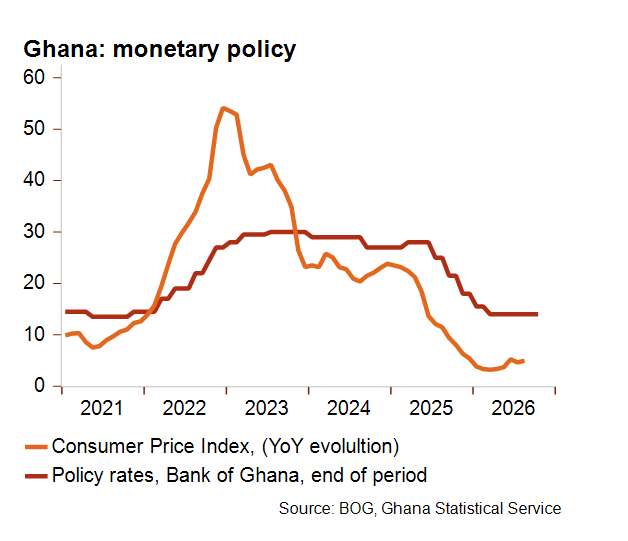
Ghana’s business environment indicators have continued to improve despite an unfavourable global environment. Economic growth is expected to remain robust at around 5% over the coming years. Tight monetary policy brought inflation down from its 54% peak at the time of the sovereign default in late 2022 and helped keep it at around 5% in 2026. The cedi appreciated sharply in 2025, largely reversing the severe depreciation experienced during the public debt crisis, and has remained broadly stable in 2026. This performance has been supported by a substantial current account surplus, driven mainly by strong gold export revenues. In addition, improving macroeconomic conditions have supported a gradual recovery in private-sector credit, easing financing constraints for businesses. Nevertheless, inflationary pressures have re-emerged due to the impact of the conflict in the Gulf region on international oil prices and on food and fertiliser costs. Combined with persistent social pressures, this continues to pose a risk of civil unrest.
- Spain: downgrade from C/G to D/G
Spain’s economy has remained resilient despite significant external headwinds and has outperformed the euro area. According to the OECD, real GDP growth is forecast at 2.2% this year, supported by solid domestic demand, a strong labour market and investment projects in the final implementation phase of the EU Recovery and Resilience Plan.
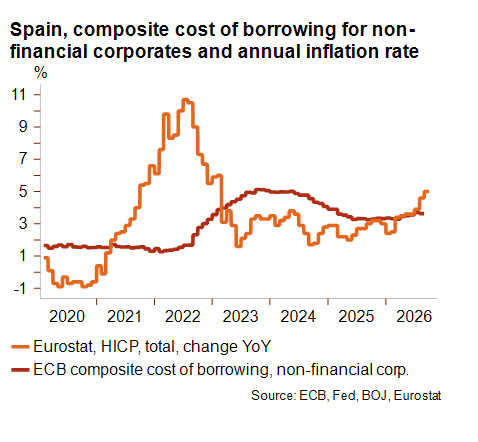
However, risks to Spain’s economy are tilted to the downside. Despite the large share of renewables in the electricity mix, the broader energy shock pushed inflation to an elevated 5% in September, according to Eurostat, driven by higher fuel prices, lubricants and package holidays. What is more, in response to rising euro-area inflation, the ECB raised its key interest rates for a second time in September, following an initial increase in June, while heavy borrowing needs in the region’s major economies have also driven up long-term government bond yields. These developments will inevitably raise borrowing costs for non-financial companies across the euro area, including in Spain, further weighing on corporate credit growth. Given these downside risks, Spain’s business environment risk rating was downgraded by one notch, bringing it into line with most other eurozone countries, which are rated D/G or E/G.