
Red Sea: Critical maritime corridor faces security challenges

Event
The Red Sea is one of the world’s most important maritime corridors, linking Europe, the Arabian Peninsula, the Horn of Africa and the wider Indo-Pacific. Under normal conditions, around 10% of global seaborne trade passes through this route, making it a vital artery for trade between Europe and Asia and an important transit corridor for energy exports from the Gulf. Nevertheless, like other maritime corridors in the region, most notably the Strait of Hormuz, it faces significant security risks amid the challenging geopolitical situation.
Analysis
Commercial shipping transiting the southern Red Sea, the Bab el-Mandeb Strait and the Gulf of Aden has been disrupted since the Houthis began attacking vessels in late 2023, reportedly in support of Gaza. Traffic struggles to recover and remains well below pre-2023 levels, even after attacks subsided. Persistent security risks push many shipping operators to continue reroute vessels around the Cape of Good Hope, lengthening journeys and raising operational costs.
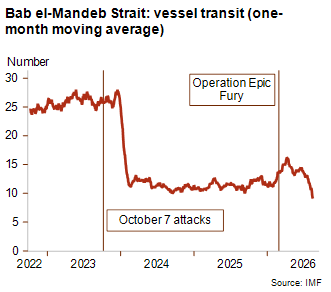
In spite of this situation, the conflict in the Middle East and the blockade of the Strait of Hormuz have increased the strategic importance of the Red Sea. This maritime corridor has emerged as an alternative outlet for Gulf trade, particularly for Saudi oil exports. Riyadh is relying on the East-West Pipeline, its Red Sea ports and the Bab el-Mandeb route to bypass the Strait of Hormuz, allowing it to export a significant volume of oil. The corridor also serves as an important route for imports into the region and for overland distribution to neighbouring countries.
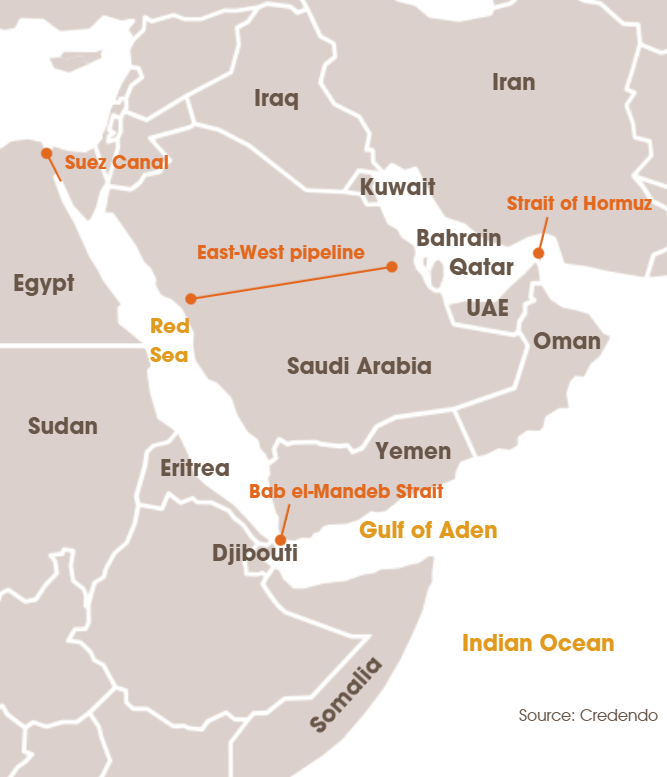
Security risks, however, are also on the rise. On 20 July, amid rising tensions with Saudi Arabia, the Iran-backed Yemeni militia, the Houthis, announced a maritime embargo on Saudi ports and began targeting vessels attempting to breach the blockade. These actions have further disrupted traffic through the Bab el-Mandeb Strait. A prolonged disruption of shipping through both the Strait of Hormuz and the Bab el-Mandeb Strait would deepen the economic impact on the region and the global economy by further disrupting exports and exacerbating supply chain pressures.
Moreover, the recent attack on the port of Damietta in Egypt highlights the vulnerability of infrastructure associated with the Suez Canal route.
Piracy has also re-emerged as a concern in the Gulf of Aden, the Somali Basin and the Western Indian Ocean, as weak government capacity in Somalia limits the country’s ability to exercise coastal control. However, the impact on commercial traffic is mostly contained, as vessels generally continue to operate with additional security measures, including armed guards on board in higher-risk areas.
Somalia’s limited security capacity has increased the importance of international efforts to secure regional shipping lanes. This has reinforced Djibouti’s role as a regional security hub. Located near the Bab el-Mandeb Strait, the country hosts military facilities operated by several foreign powers, including the United States, France, China, Japan and Italy. While these installations help protect one of the world’s busiest maritime corridors and generate valuable rental income for Djibouti, they also increase Djibouti’s exposure to regional geopolitical tensions.
The Red Sea’s strategic importance, as outlined above, has also intensified regional competition. Gulf states, Türkiye and other external actors are becoming more involved in East Africa through investment, development financing, political support and arms transfers. Gulf regional players invest in strategic infrastructure, including ports such as Berbera in Somaliland, while cultivating ties with local political actors. While such engagement has supported economic development, in some cases, external powers have backed competing factions in pursuit of strategic influence and access. Sudan provides the clearest example, where support for opposing sides is widely believed to have prolonged the conflict and complicated efforts to reach a negotiated settlement.
In summary, recent geopolitical developments in the Gulf have highlighted the strategic importance of the Red Sea maritime corridor. As the situation in the Middle East remains fluid and given limited diplomatic progress, risks to maritime traffic remain substantial. While some countries in East Africa are also facing political instability, the spillover effects on maritime traffic are expected to be far more limited.
Analysts: Andres Hernandez Cardona (a.hernandezcardona@credendo.com) and Jonathan Schotte (j.schotte@credendo.com)