
Georgia: Robust economic growth amid rising tensions with the EU

Event
On 17 December 2025, Georgia’s parliament, dominated by the ruling Georgian Dream party, passed an amendment abolishing out‑of‑country voting, requiring all ballots to be cast domestically. The change effectively disenfranchises much of the Georgian diaspora – estimated at around one‑third of the citizens – and was widely criticised by the opposition parties and civil society as a targeted move against expatriate voters, who tend to favour the opposition.
The amendment was adopted amid heightened political tensions following the October 2025 municipal elections, which were boycotted by all major opposition parties over alleged intimidation and media bias. With Georgian Dream’s candidates running largely unopposed, the elections triggered protests in Tbilisi and other cities.
Impact
The ban on diaspora voting has become a focal point of Georgia’s democratic backsliding. Together with the imprisonment or exile of opposition figures and alleged media and judicial manipulation, it marks a sharp reversal from the more pluralistic environment of recent years. The boycott of the 2025 local elections by the opposition (who intended it as a protest) has further weakened their position and left much of local governance in Georgian Dream’s hands.
Internationally, these developments have strained relations with the EU. Despite having granted Georgia the EU candidate status in December 2023, Brussels has since frozen progress, withdrawing EUR 121 million in reform‑linked grants in late 2024 and halting accession talks in mid‑2025 due to democratic regression. The deterioration in relations could result in further financial support cuts, weaker investor confidence and potentially the suspension of visa‑free travel to the Schengen Area.
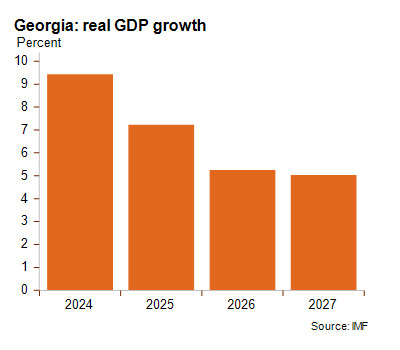
As ties with the West fray, Georgia moves closer to Russia. Tbilisi refuses to join Western sanctions against Russia over the Ukraine war. Indeed, Georgia has experienced significant economic growth after the war in Ukraine, benefiting from increased trade and capital flows, with an influx of Russian citizens boosting the IT, real estate and services sectors – resulting in double-digit GDP growth in 2022 and sustained strong performance. Even though that impact has now mostly faded, growth remains robust, as it can be seen in the graph below.
Strategic realignment away from the West can be seen as rational in the short to medium term, given Georgia’s structural constraints. The country lies outside the EU’s security perimeter, and the 2008 war underscored the limits of Western support. Against this backdrop, maintaining workable relations with Russia could help reduce immediate security and economic risks. That being said, the approach carries longer‑term vulnerabilities. Russia continues to station troops in Georgia’s breakaway territories of Abkhazia and South Ossetia, retaining leverage to exert political pressure and challenge Georgia’s sovereignty. In parallel, Georgia could face the risk of secondary sanctions if Western partners conclude that it facilitates Russia’s circumvention of existing restrictions.
These trade offs are unfolding amid shifting regional dynamics. Progress in the Armenia-Azerbaijan peace process could lead to the reopening of transport corridors that bypass Georgia, potentially diverting transit trade away from its territory. The loss of Georgia’s role as the primary overland transit route in the South Caucasus would weigh on its logistics and transport sectors and reduce its strategic economic relevance to both the East and the West.
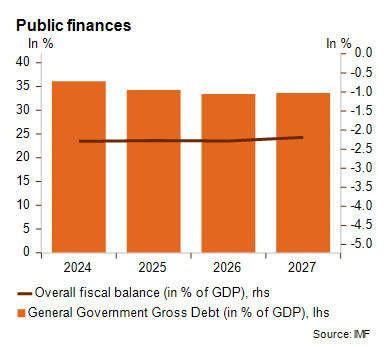
In a context of political uncertainty, Georgia’s economic fundamentals remain a bright spot. Public finances are anchored by a rule‑based fiscal framework that caps the budget deficit at 3% of GDP and public debt at 60% of GDP. The authorities have broadly adhered to this framework over recent years. Debt has remained contained at around one third of GDP, while the fiscal deficit has stayed limited and stable (see graph below).
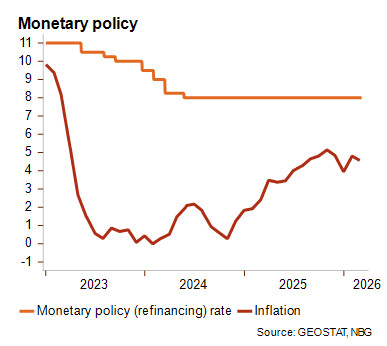
Strong domestic demand combined with external food price shocks recently begun to exert upward pressures on inflation. After a period of low inflation in 2023, headline inflation rose to around 5% in late 2025. The central bank has maintained a moderately tight monetary policy stance to keep inflation under control. Renewed geopolitical tensions involving Iran are likely to further raise inflation through higher oil prices, which would quickly translate into higher domestic fuel, energy and transport costs given Georgia’s heavy reliance on energy imports.
In essence, Georgia will continue to face a dual reality. On the one hand, the country maintains solid economic growth and relatively strong macroeconomic indicators. On the other, political frictions linked to recent political and legislative decisions continue to weigh on its relationship with the West. Domestically, this strained political environment translates into persistent social tensions. While large‑scale street mobilisation has moderated compared with the peaks of late 2024, underlying political polarisation and pressure on opposition actors and civil society remain elevated. Georgia’s current MLT political risk rating (5/7) and ST political risk rating (4/7) reflect this reality.
Analyst: Jonathan Schotte – j.schotte@credendo.com