
Qatar: Robust macroeconomic standing and external buffers support medium-term outlook

Economic outlook projected to improve significantly compared to underwhelming pre-pandemic years
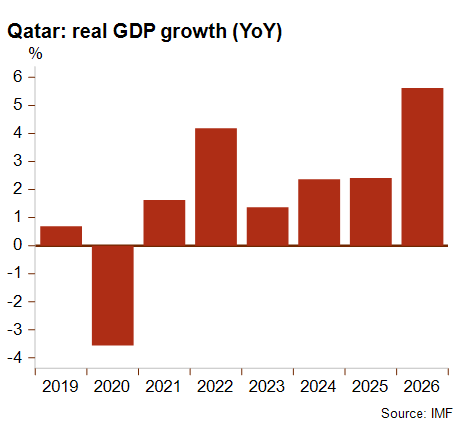
After some fluctuations in recent years, real GDP growth started to pick up in 2024 and should further accelerate over the medium term, bolstered by projected large LNG production expansion and diversification efforts under the Qatar National Vision 2030 strategic framework. Growth is expected to exceed 5.5% on average during the 2026-28 period.
Fiscal and external positions are also expected to improve
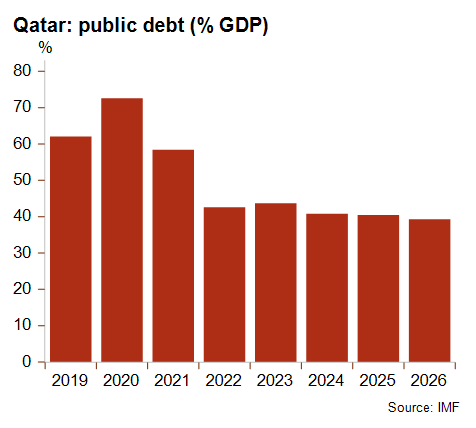
Over the past few years, Qatar’s public debt has decreased significantly, from 62.1% of GDP in 2019 to an estimated 40.8% of GDP in 2024. Moreover, after an accumulation over the last decade, the high external debt should continue its relative downward trend started last year. Last but not least, Qatar has accumulated substantial external assets within its sovereign wealth funds (Qatar Investment Authority), which mitigate financial risk, and foreign exchange reserves remain at more than adequate levels relative to import needs.
The improvement of public and external positions is expected to continue despite the ongoing oil market volatility. Qatar’s lower exposure to climate transition risks – given its dependence on LNG rather than oil – and its comparative advantage in gas extraction and transportation is an important risk mitigator. In fact, although hydrocarbon revenues accounted for most of the public revenue, only a minor part was directly attributed to the oil sector. Moreover, despite their decline, oil prices remain above Qatar’s external and fiscal break-even oil prices (estimated at USD 36.4/barrel and USD 47/barrel respectively in 2024). Hence, Qatar is projected to maintain fiscal and current account surpluses over the medium term, averaging 2% and 12.3% of GDP respectively, and therefore to continue to accumulate foreign assets. Nevertheless, the ongoing phase of global LNG expansion – primarily driven by the US, with Qatar also playing a major role – combined with risks of a rapid global shift away from all hydrocarbon energy sources, represents important risks for the country.
Geopolitical dynamics continue to weigh on Qatar’s outlook
The country is very exposed to regional developments, as attested by the two recent episodes on its territory: the Iranian attack on the US Al Udeid air base in June and Israel’s strikes targeting Hamas leadership in September. If fully implemented, the US-led Gaza peace initiative would represent a major security and political development for the region. While recent developments are encouraging, many sensitive points remain to be negotiated, which may present significant challenges in advancing to subsequent phases of the peace deal. Additionally, several other unresolved regional questions – chief among them is Iran’s nuclear programme – remain important sources of tensions. Escalating tensions between Iran and Israel would represent a significant risk for Qatar, given its reliance on the Strait of Hormuz for trade, exposed desalination plants on the Gulf coast and US military presence. Even in the absence of direct material impact on Qatar, important regional tensions could undermine investor confidence, reduce tourism flows and/or disrupt trade flows – which would pose risks to the country’s economic diversification projects.
Despite the challenges facing the country, Qatar’s current medium- to long-term political risk classification (in category 3/7) is supported by the positive medium- to -long-term outlook and robust external position.
Analyst: Andres Hernandez Cardona – a.hernandezcardona@credendo.com